Notes A
TOPIC 1 – INTERACTION AMONG THE PEOPLE OF AFRICA
TOPIC 2 – SOCIO-ECONOMIC DEVELOPMENT AND PRODUCTION IN PRE-COLONIAL AFRICA
TOPIC 3 – AFRICA AND EXTERNAL WORLD
TOPIC 4 – INDUSTRIAL CAPITALISM
….
AMAZING HISTORICAL
SITES IN AFRICA – PART 2
4. Meroe
The ruins of the ancient Kushitic city
of Meroe lie on the east bank of the Nile River in what is
now Sudan. The city was established in the 1st millennium BCE. It became
the southern administrative center for the kingdom of Kush about 750 BCE and
later became the capital. It began to decline after being invaded by Aksumite
armies in the 4th century CE. The ruins were discovered in the 19th century,
and excavations in the early 20th century revealed parts of the town. The
pyramids, palaces, and temples of Meroe are stunning examples of the
architecture and culture of the kingdom of Kush.
5. Isimila Stone Age site, Tanzania
The Isimila Stone Age Site is a
historically rich archeological site that is located outside of the town of
Iringa. Archaeologists have found tools, stone artifacts and bones in a dry bed
that was once a shallow lake from what they believe were from the early
hominoids that occupied the area. The site preserves artifacts that give a
glimpse on the lives and activities of early human and animal civilization, and
has beautiful granite rock relieves. A walk through the canons can be booked
via a travel agency, and a tour will consist of a brief introduction to the
formation of the site and an overview of the fossils and tools displayed before
going on a scenic walk through the canyon. The tour takes about 3 hours, and it
usually starts early in the morning before temperatures start to soar. Tours
can be booked through a travel agency.
6. Timbuktu
Timbuktu, a city in the western African
country of Mali, was a historically important trading post on the trans-Saharan
caravan route and was a center of Islamic culture. It is located about 8 miles
north of the Niger River on the southern edge of the Sahara. Timbuktu served as
a center of Islamic scholarship under many African empires. It was home to a
25,000 student university and other madrasahs that served as the foundation for
the spread of Islam throughout Africa from the 13th to the 16th centuries. Many
sacred Muslim texts were carried great distances to the city for the use of
prominent scholars from Cairo, Baghdad, Persia, and elsewhere who resided in
Timbuktu. The teachings of Islam from astronomy and mathematics to medicine and
law were collected and produced here in the form of several hundred thousand
manuscripts. Many of them still remain but in perilous condition, to form a
valuable written record of African history. Timbuktu’s former status as an
Islamic center is seen in its three great mud and timber mosques: Djingareyber,
Sankore, and Sidi Yahia which recall the city’s golden age.
HOW
TO PRESERVE HISTORICAL INFORMATION – PART 2
Proper storage
requires consideration about everything that could come in contact with the
documents. This includes the geographical location, building construction,
temperature, light, packing materials, and so on. Knowing the potential risk
factors when choosing storage methods can prevent unnecessary damage to already
fragile documents.
While not every
collection can or needs to be housed to meticulous standards, preservationists
have a clear outline of the types of potential hazards to look for and various
precautions available to mitigate risk to the collection.
4. Location Selection
Location refers to
the physical location of the storage building and the environmental dangers
that this area could pose to the building. While no place is absolutely safe
from all natural or man-made disasters, it is possible to select storage
locations that minimize known risks. Consider the environmental risk factors of
the area. If flooding is a problem, a location outside all flood plains and
known flooding zones is preferable. If wildfires or earthquakes are common, is
the storage building prepared to withstand such disasters?
5. Submit a
nomination to an endangered places list.
When a site is
threatened by demolition, alteration, or neglect, nominate it to a local
organization’s endangered list. This is an excellent way to generate publicity,
raise awareness of threatened Modern and recent past places, and explain to a
broader audience why these types of places are significant and worthy of
protection.
6. Label your
stuff
Even if you don’t have all the information about the ‘who’,
‘what’, ‘where’, and ‘why’ of family archival materials, it’s important to
capture what you can. A family member in possession of records can take for
granted their knowledge and memory when it comes to providing descriptive
information. It is so crucial when preserving family history to externalize
that knowledge by accurately labelling important documents, photographs,
audiovisual materials, and other items so future generations will know who and
what they’re looking at! Use a soft graphite pencil when writing descriptive
information directly onto archival records, applying minimum pressure and
writing only on the back-side edges to prevent indentation.
Pens and markers
can bleed through to the front side and accelerate deterioration of the
material, plus pencil can easily be corrected in case mistakes are made.
Another option, if you think descriptions are going to get particularly wordy,
is to number your documents, photographs, and other items and provide a
corresponding description on an additional sheet of paper.
..
AFRICA AND THE EXTERNAL WORLD
Early contact with the Middle East and Far East
One of the negative impacts of Africa’s contact with the Middle East and Far East was the integration of Africa in the international economic system. The contact between east Africans and people from the Middle East and Far East started as early as 200bc the contact was developed trough trade relation, some of the early visitors were Persians, Phoenicians(Syria), Indians, Chinese, Lebanese, Arabs etc
This trade contact intensified between the 8th and 10th century AD when more traders from china, Indonesia, India, and the Arab world come to trade, such commercial contact are evident from archaeological findings such as china, coins, beads, and foreigners tombs in areas like Kilwa Kisiwani and old bagamoyo
SOCIAL MOTIVES OF THE CONTACTS BETWEEN AFRICA, THE MIDDLE EAST AND FAR EAST
- Spreading the Islamic religion, I slam began in the middle east in the 7th century AD from there it spread to many parts of Asia. This resulted in strong Islamic kingdoms in the Arab word. These kingdoms wanted to spread their religion to new parts of the word including Africa
- Seeking refuge, some visitors to Africa were fleeing religious and political persecution in their own countries. They therefore came to search peaceful place to settle.
- Exploration, some came to explore the land of zanj(blacks) people and to see their culture, to explore the accessibility of various parts of African coast and the commodities available and then took their finding back to their home countries.
- Establishment of settlements, some visitors decided to live permanently in Africa. Settlements were established by different groups of visitors especially along the coast.
Economic motives
- Commercial exploration,some visitors came to explore Africa and assess its resources, they wanted to know the climatic conditions, mineral resources, wild life resources, and economic activities found in the continent. This way could help them to plan how to exploit resources available, eg sultan sayyid said of Oman.
- Trade.Many early visitors were interested in obtaining goods from Africa to take back to their home countries; they brought merchandise from their homes to trade with
Commodities exchanged during the contact
POSITIVE IMPACTS OF THE CONTACT
- The rise of costal city states eg Mogadishu, lamu, pate, Zanzibar, Mombasa, malind, kilwa and sofala. They grew into cities due to settlement of foreigners as well as local people who traded with people from Middle East and Far East.
- Development of Swahili language and culture, the language and culture developed due to intermarriage between the people of east Africa with the Arabs and Persians, Kiswahili consists of roughly 65% bantu words 30% Arabs a few Indian words and words from other languages
- Spread of Islam, Islam was introduced along the coast of east Africa and later the interior was the unifying factor for the various communities.
- New architecture designs, example they introduced building using stones like in places like kilwa kisiwani and Zanzibar in a style similar found in Persia.
- Introduction of new style of dressing, especially those who adopted Islam adopted new style of dressing including buibui, kanzu, barghashia etc
- Intermarriage, the impact of this was the creation of new race (mulatoes)
NEGATIVE SOCIAL IMPACTS
- Cultural interference as some Africans forgot their own traditions eg religion, dressing mode, foods and mannerism in fever of foreign ones,
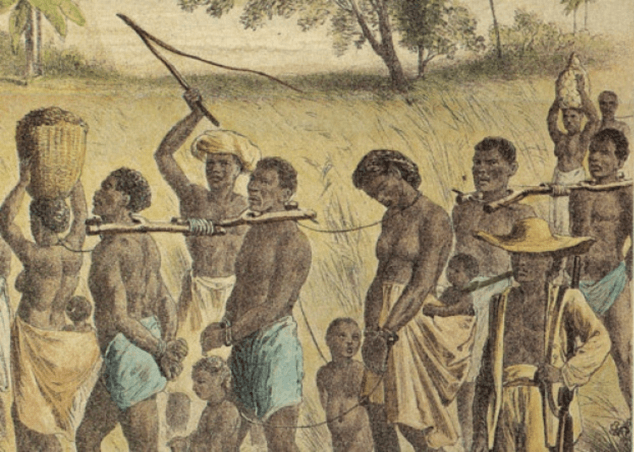
- War fare and depopulation, this was due to slave trade
- Social Stratification, through trading with foreigners some African acquire great wealth this lead to the emergence of super rich people in Africa
POSITIVE ECONOMIC EFFECTS
- Introduction of new crops, like rice, wheat, cloves, sugarcane, oranges
- integration of Africa into the world economy the Africans produced commodities which were sold to the rest of the word, also the report written by foreigner about Africa was sent to other countries throughout the word this helped Africa to be known by the external countries
- introduction of money economy
- introduction of new technology like advanced navigation technique, arts of keeping records by writing,
NEGATIVE ECONOMIC IMPACTS
- unequal exchange
- slave trade
- exploitation of African natural resources
- decline of local industries
CONTACTS WITH EUROPE
THE PORTUGUESE AT THE EAST AFRICAN
COAST 1500 – 1700 A.D
The Portuguese were the first Europeans to have contacts with the people of the East African Coast. They were adventurous and in search for the sea route to India. This led them to the East African Coast where they stayed for 200 years.
PORTUGUESE CONQUEST OF THE COAST
1500-1510
In 1497 King John 11 sent Padro da Covillha on a land journey to India to gather information about the Eastern trades and the sea routes.
In 1498 Bathromew Diaz sailed around the Cape of Good Hope, thus proving that there was a way round South Africa to the Indian Ocean. With this information in mind Vasco da Gama set out with three ships bearing a red cross. By 1499, he went back and sailed down the coast to Portugal. Between 1497- 1499 Vasco da Gama at the command of King Emmanuel the fortunate of Portugal visited Mozambique, Mombasa and Malindi on his way to India.
In response to Vasco da Gama’s expeditions, the king of Portugal sent fleets of ships to conquer the important trading towns of the East African coast.
In 1500 Pedro Alvares Cabral attempted to capture Sofala with its Gold trade but he failed.
In 1502 Vasco da Gama came back with 19 ships aiming at capturing Kilwa because it was the most important and prosperous. He captured the palace, imprisoned the Sultan and only released him when he accepted to pay tribute to Portugal. However, he stopped it when the Portuguese left. From Kilwa he invaded Mombasa, which tried to get assistance from Malindi but since they were great rivals Malindi refused to give assistance, this disunity made the work of conquest easy.
In 1503 Ruy Glaurence Ravasco was sent with a number of ships and forced the islands of Mafia and Zanzibar and other towns to pay tribute to Portugal.
In 1504, Lopez destroyed gold trade at Kilwa. Attacks were too much on the harbour that trade came to a standstill. But again the Arabs failed to unite to fight the Portuguese.
In 1505 Francisco D’Almeida arrived at the coast on his way to Gao where he had been appointed the first Portuguese viceroy (governor) of the Eastern empire. With 1500 men and 20 ships, he attacked Sofala which surrendered without struggle because she was tied of Kilwa’s rule and therefore preferred the Portuguese to fellow Arabs. His forces continued Northwards and attacked Kilwa. The Sultan and his followers took off to the bush while the Portuguese looted and burnt down before he departed to India.
In 1506 – 1507 Tristian Da Cunha took the Northern towns of Socotra, Oja, Brava and Merka towns that submitted without struggle were only asked to pay tribute to Portugal, Malindi was even excused from paying tribute due to her friendship with the Portuguese.
In 1509 Alba quiqui captured the remaining towns i.e the work of conquest was completed with taking the islands of Pemba, Mafia, Zanzibar.
In 1510 for purposes of effective administration, the coast was divided into two strips i.e. the Northern strip north of Cape Delgado with headquarters at Malindi while the Southern strip had headquarters at Mozambique.
The strong hardedge the coastal people had for the Arabs might have made them easily accept Portuguese authority.
At the time of the Portuguese invasion, the coastal states were already weakened by the expansionist policy of Kilwa ,for example, Sofala supported the Portuguese rather than being under Kilwa.
The Portuguese were able to realize their goals in the East African coast through Vasco da Gama’s expedition of 1498.
REASONS FOR THE COMING OF THE PORTUGUESE AT THE EAST AFRICAN COAST
- The need to establish a commercial empire in order to get the products of East Africa e.g. ivory, gold, silks and spices were mainly controlled by the Arabs merchants.
- They wanted to get control of the main trading towns, e.g. Kilwa, Mombasa etc.
- They wanted to defeat the Moslem traders and rulers who had monopolized the Indian Ocean trade.
- They wanted to prevent other European rivals from gaining access to the Indian Ocean Trade e.g. the French, Dutch, British
- Desire to get revenue for the development of their country.
- The Portuguese wished to share in the profits of the Indian Ocean Trade by imposing taxes and forcing wealthy coastal towns to pay tribute to the king of Portugal.
- The coast had natural harbors where ships could anchor on their way to and from the East for fresh food and water. The Portuguese therefore wanted to establish a calling station for resting, refresh, treating the sick, repairing wrecked ships e.t.c
- The coast was strategically located and this made it easy to control sea pirates and other rival powers.
- They wanted to revenge on the Moslem Arabs who had conquered Portugal in 711 AD by converting them to Christianity and stop the spread of Islam i.e. the Arabs had ever run the Iberian Peninsula and forced the Christians to accept Islam.
- They hoped to get assistance of King Prester John thought to be in the interior of north –east Africa. They hoped the king would help them in their crusade against the Moslems.
- They had hope of stopping Egyptians and Turks from sending military aid to their fellow Moslems on the coast.
- They were interested in exploration and adventure; this was a period of Renaissance (means to be born again/change) in Europe. Hence hoped to search for the unknown, new knowledge and sailing across un mapped seas.
- Desire to acquire revenue for the development of their country.
WHY THE PORTUGUESE DEFEATED THE EAST AFRICAN COASTAL TOWNS/WHY THE PORTUGUESE WERE SUCCESSFUL
- They had superior weapons e.g. cannon guns which made terrible noise and threw people in panic as compared to the poor musket guns of the coastal Arabs.
- They had well trained soldiers with superior skills of fighting compared to the coastal people who had no permanent organized army e.g Vasco Da Gama, Francisco D’Alemeida were ruthless army commanders which helped them to defeat the coastal dwellers.
- They had better and faster ships (carracks) well equipped for naval warfare. The Portuguese soldiers wore Amour on their bodies and helmets on their heads, which protected them from the weapons of the coastal people.
- The coastal towns were disunited which gave chance to the Portuguese to fight isolated enemies e.g. Malindi refused to unite with Mombasa due to local conflicts. Some cooperated with the invaders giving them food and bases e.g. Malindi and Sofala.
- Some coastal towns like Kilwa were caught unaware. The Portuguese employed cruel methods of fighting like burning down towns and surprise attacks.
- The ships acted as stages against the hostile weapons of the coastal people.
- The coast had natural burners and was not open to attacks.
- The constant attacks on the coastal towns by the Galla, Zimba and Turkish e.t.c had weakened their defence.
- The Portuguese were financially equipped and therefore supported their solders because they wanted to control the East African trade.
- The coastal states had very weak economies that could not sustain prolonged fights especially against the economically strong Portuguese.
PORTUGUESE ADMINISTRATION AT THE COAST;
The political, economic and social way of life of the east African coast under the Portuguese rule
Political
By 1510, the conquest of the East African coast was over and administration fell into the hands of the Portuguese. For easy administration, the coast was divided into two zones;
- The area North of Cape Delgado was ruled by the Captain at Malindi.
- The area South of Cape Delgado was ruled by Captain at Mozambique.
By 1507, Mozambique had become the headquarters of the southern portion in charge of a Portuguese viceroy. Another Portuguese captain in charge of the area North of Delgado was stationed at Malindi. Both captains were answerable to the Portuguese viceroy at Goa on Indian coast at the General headquarters. Cape Delgado was made the mid point of the East Africa possession. Sofala was made the regional headquarters but still under the charge of the captain who took his orders from the vicory at Goa. Later, the Captain in the North was stationed at Mombasa after the construction of Fort Jesus in 1593 because they were rebellious. Other forts and garrisons were established at Sofala and Kilwa.
The Portuguese captains were responsible for the collections of tributes from coastal rulers. They imposed the customs dues on all imports and exports. They were also responsible for the suppression of rebellions on the coast. The Portuguese had problems with administration because they could not provide enough troops to all garrisons their strongholds.
The Portuguese captains collected import duties, export duties and tributes from the local leaders. The Portuguese were more interested in gold trade which passed in Sofala land they ignored the towns.
Unfortunately, they failed to develop this trade because of the following;
There were wars in the mining areas between the Portuguese and Coastal people.
As a result the Portuguese were so cruel that any sign of disobedience was punished with maximum brutality to serve as a warning to others who might choose to rebel. This partly explains the unpopularity of the Portuguese on the coast.
Social
The relationship with the subjects was not good. They lived in isolation of each other by race and religion. The Portuguese established their own settlements, built their own churches and had their own priest. This could be the reason why their religion was rejected and hatred increased.
In addition, the few Portuguese officials were corrupt, plundered and ordered destruction on the coastal town. All this earned them hatred and opposition from the people and it was not a surprise that they were nicknamed “AFRITI” meaning Devil.
The Portuguese did not mix freely with Africans because they considered themselves to be a special race.
During the Portuguese reign, the glory of the coastal states was no more. The high standards of living the coastal people had enjoyed were no more. The trade that had made them rich was declining. Many buildings were in ruins and there was widespread poverty and misery.
REASONS THAT LED TO THE DECLINE OF THE PORTUGUESE AT THE EAST AFRICAN COAST (problems/challenges they faced)
- Portugal was a small country that could not provide enough administrators and officials for such a large coastline that extended from Sofala in the south to Mogadishu in the north.
- It had few soldiers and could not keep fortified garrison along the coast.
- Authority was left in hands of incompetent and corrupt officials who were after enriching themselves.
- The Africans hated the Portuguese due to differences in religion, that is to say, Moslems against Christians (Portuguese).
- The Portuguese were cruel, harsh and brutal, they always punished the coastal people whenever they attempted to rebel and made them to be hated.
- The Portuguese also used divide and rule policy for example, they allied with Malindi against Mombasa.
- The territory was too big and long for effective control and administration.
- There was decline of trade due high taxes on imports and other restrictions hence smuggling of goods, which affected the Portuguese economy.Due to decline in trade, the people became poor and dissatisfied and they continuously rebelled.
- The Portuguese failed to support their own allies at the coast, some even betrayed them.
- Portugal had been forced into a union with Spain between1580–1640 which weakened her control of the trading colonies as she was no longer interested in the overseas empire.
- Portugal was challenged by other European powers, which began competing with the Portuguese in the Indian Ocean Trade e.g. Dutch, English, French, Turks and others.
- The coastal people found useful allies against the Portuguese due to their bad rule e.g. Turks, Oman, and Arabs
- They were faced with constant rebellions along the coast. This greatly disrupted life at the coast e.g. Pate, Mombasa
- Tropical diseases which claimed their life like smallpox, malaria making it difficult for them to administer the coast effectively.
- The Portuguese were greatly weakened by a group of cannibals the Zimba, who attacked the East African coast.
- The unhealthy climate made the area unattractive for them to work for instance, some places where too humid and hot while others where too cold.
- The distance between Portugal and the East African coast was too far hence reinforcement delayed.
- There was a problem of communication barrier, the Portuguese refused to learn the African languages and these made their administration difficult.
- The income obtained from the gold trade was not enough to pay for administration i.e. soldiers and officials.
- The Portuguese lost muz in 1622 to the Persians during the struggle with Arabs and in 1650 the Oman Arabs won back Muscat.
- The Capture of Fort Jesus their stronghold in 1698 by the Omani greatly contributed to their decline.
RESULTS OF PORTUGUESE STAY AT THE COAST OF EAST AFRICA
- POSITIVE:
- The Portuguese built Fort Jesus at the coast in Mombasa in1592/3 which became a fortress and later a tourist attraction for centuries.
- They enriched the Swahili language with an addition of 60 words e.g. emeza meaning table and pesa meaning money.
- They introduced new crops from South Africa of which many have become staple diet for many East Africans e.g. cassava, pawpaws, maize, oranges, sweet potatoes, guavas, pineapples and mangoes
- They made an improvement in ship building. During their stay on the coast, many architects came in from India and Europe.
- There was establishment of closer trading links between the coast and India.
- They introduced new farming methods for example they encouraged the use of cow dung as manure.
- They led to the coming of more European and Asian traders and craftsmen especially those who helped in the building of Fort Jesus.
- They broke the Muslim- Arab monopoly of the Indian Ocean Trade.
- Negative:
- Trade declined due to the constant wars and rebellions and heavy taxes imposed.
- There was decline of the coastal towns because many were burnt down and left in ruins for example Kilwa and Mombasa.
- There was widespread poverty and misery among the coastal people due to decline in trade.
- There was heavy loss of lives during the attacks.
- There was destruction of property like buildings and crops, which led to famine and starvation.
- The coastal people suffered oppression and brutality under harsh rule of the Portuguese.
- There was depopulation due to wars in the areas smuggling developed because the Portuguese had failed to establish proper trading links with the Interior.
- Some towns were prevented from trading with their initial partners which led to their decay e.g. Gedi
- They led to the European interest at the coast hence leading to the colonization in the 19th Century.
DUTCH SETTLEMENT AT THE CAPE,
South Africa before the coming of Europeans
Before the coming of Europeans the earliest inhabitants of south Africa were the san , khoikhoi, and the Bantu
THE SAN (Bushmen)
- Were physically smaller, yellow or light brown skin, Traditionally- hunters & gatherers.
- They were distinct people linguistically, ethnically and culturally.
- they used click languages
- They had no permanent settlement
- They lived in small patrilineal bands of between 20-200 people
KHOIKHOI (Hottentots)
- Were pastoralists- had more elaborated socio-political organisation than the San.
- They were distributed in patrilineal bands of up to 2500 members.
- Before arrival of the whites, they conducted trade with their Bantu neighbours.
- The san helped the khoikhoi to graze their animals, due to frequent contact between these two groups they are sometimes referred to as one group the khoisan
THE BANTU PEOPLE
Centuries before whites settled in South Africa, Bantu-speaking groups migrated from west central Africa and settled in a fertile region between the Drakensberg Mountains and the Indian Ocean.
The bantu group is made up by people like the Tswana, Venda, Gaza, Zulu, Ndebele, Swazi, Shona, etc ,The bantu lived in settled life and conducted agriculture, also they introduced iron technology in south Africa.
DUTCH SETTLEMENT, 1652
It was an outcome of the emergence of Dutch Republic (the Netherlands) as the strongest mercantile state in 17th centurywhich controlled major trades in spices. The Dutch traded with the khoikhoi and san through the batter system, They exchanged tobacco, alcohol and other goods for honey, skin, ostrich etc
They formed the Dutch East Indies Company (D. E. I .Co) in 1602 under the leadership ofJan Van Riebeck and it was involved in trade trading activities between Europe, Africa and Asia During this period, the Portuguese discovered the route to India and the Dutch used the same route.
MOTIVES OF DUTCH SETTLEMENT AT
THE CAPE;
- Refreshment,
- fresh water, the station at the cape served as stopover point for Dutch ships on their way to or from India, the sailor could rest and get fresh food and water
- The Dutch wanted to control Indian ocean trade which was dominated by Portuguese, the Dutch east Indian company was active in the Atlantic ocean and Indian Ocean in the 17th century
- Dutch settlers wanted to establish forms on which they could grow different types of crops , combat the situation.
- Many sailors died of scurvy when they were on the way to India so they wanted to establish gardens at the cape for producing vegetable so as to get rid of scurvy
- Watering place for British & Dutch vessels.
- The cape had temperate climate similar to that of Europe, this attracted the Dutch to establish settlement there,
IMPACTS OF THE DUTCH SETTLEMENT AT THE CAPE
- Enslavement of Africans, the Boers established large plantations were they kept animals and grew crops such as potatoes, pumpkins, pineapples, Africans were forced to provide labor in these farms,
- Displacement af African communities, the Dutch displaced Africans from fertile land to unfertile land and took their livestock by force, and the Dutch used the African fertile land to establish their farms.
- Social segregation, the Boers had negative attitude towards Africans, they used religion to justify their attitudes towards Africans, they regarded Africans as stupid, lazy and kaffir and they thought themselves superior, so they mistreated and exploited Africans.
- Expansion of Europeans settlement, in 1652 Van Riebeeck arrived at the cape with just a few people about 120, in 1685the population had increased to 150 people. Dutch activities also caused other Europeans to come to South Africa, including the British and the French.
- Increase of warfare, there were many warfare as Dutch tried to force the Africans out of their land, eg the three kaffir war took place in 1779-1781, 1789-1793,1799-1893, Africans wanted to retain their independence while the Dutch wanted to rule them and take their land, this war caused insecurity, loss of life, destruction of properties etc
- Introduction of new culture, The Boer introduced Dutch culture in South Africa, their way of life was different from that of Africans, they also began to speak Afrikaans, the language which is based on Dutch, and also had words from other language like Portuguese and khoikhoi.
- Introduction of new diseases, the Europeans bought with them foreign diseases to which the Africans had no natural immunity, eg small pox reduced the khoikhoi population from 200,000 in 1652 to 20,000 by 1767
BRITISH INVASION OF SOUTH AFRICA
By 1795, British invasion of South Africa was inevitable. In 1794, French occupation of Holland provoked British occupation of the Cape of South Africa, to prevent their sea route to India..
MOTIVES FOR THE BRITISH OCUPYING
THE CAPE
- British had to compensate their loss of American colonies by occupying South Africa
- To prevent the sea route to India from falling in the hands of the French, British were afraid that after napoleon’s victories over the Netherlands the Dutch might hand over the cape to the French
- Industrial revolution in Europe and the transition of capitalism into its final phase of monopoly capitalism in 1870s necessitated expansionism
- .The South Africa cape was strategically located, it was an appropriate place for British ships to stop during their voyages to or from India, they could get fresh supplies and water for the remainder of their journey
TACTICS USED BY THE BRITISH TO OCCUPY THE CAPE
To ensure that they colonize the cape fully and eradicate Dutch influence the British did the following
- They introduced land legislation system, this limited the size of individual’s land, the aim of this policy was to discourage pastoralism among the Boers and encourage sedentary farming, the law was opposed by the Dutch.
- British abolished slave trade and slavery, in 1807 the British abolished slave trade in all their colonies including South Africa, Boers regarded this as interference in their affairs and their economy. The British government offered compensation for slaves but the money was only paid in London, freeing slaves endangered the economic survival of the Boers because they depended heavily on slave labour.
- English replaced Dutch as the official language at the cape,
- The British introduced English law as the basis of the legal system in south africa.
- The British gvt encouraged more of its citizens to immigrate to th cape, in 1820 some 300 British settlers arrived in south Africa, increasing the total white population by almost 12% within weeks, the British gvt gave financial aid to these settlers.
- The British abolished the restriction of internal trade that was imposed by the Dutch company officials on the farmers and other settlers at the cape, they could now trade freely without strict control from the administration, this created more export opportunity.
- In 1814 Britain was granted the Cape Colony in a treaty drawn up at the Congress of Vienna, at which European powers negotiated the end of the Napoleonic Wars (1799-1815), After 1820, ‘000s of British colonists arrived at the Cape of South Africa. The first impact of British settlement was that it led to Great trek
.
It was a process of mass migration of the Boers from the Cape Province northward fleeing away from the British rule. Almost 10% of the Afrikaners moved, with their properties and belongings
e.g. livestock, guns, arms etc. fighting with the people they meet
WHY WERE THEY MOVING AWAY FROM BRITISH RULE? (FACTORS)
- The question of abolition of slavery: Dutch economy was totally dependent on slave labour in their farms. But from 1834 the British government introduced the law to emancipate the slaves (freeing of slaves). By 1834 those who were already slaves were to remain under their owners for five years i.e. up to 1838 all slaves were supposed to be freed legally. The law specified that slave owners were supposed to be given compensation for freeing slaves, but the freed slaves were not compensated. British government paid the compensation, but the grievances of the Afrikaners was on the issue of the costs of emancipation and the loss of labour power. The fact that the British government enforced the abolition of slavery in 1830 was also due to the fact that she had undertaken industrialisation and so they supported the free market competition (the main reason for abolition).
- Ordinance 50 In 1838 the British government at the Cape announced and ordered the “Ordinance 50” which treated all natives at the Cape equally, regardless of their colour. The philosophy behind this argument was that “All people are equal before God”. This ordinance was very opposed by the Afrikaners on how the slaves could be equal with their masters. For the Afrikaners, it was difficult for them to bow before the Europeans.
- Land question Before the coming of the British forces, the Afrikaners had access to the land (they were getting nominal free land). In 1813 the British introduced land law which forced the owners to pay rent to the British. The Afrikaners were not happy because the rent was too high for them to pay to the British government. The Boers needed the vast amount of land for pastoralism. The immigration of British settlers (about 5000) and the natural increase of black population put more pressures on land.They expected to get more and getter free land in the interior.
Loss of Political autonomy The British forces established the British East Indian Company (B. E. I. Co.). They dominated all colonies & abolished the council which was formerly
- headed by the Afrikaners. All this implied the loss of political autonomy at the Cape, so they started to move away from the British rule.
- Changes in the Legal System In 1811 the British government decided that all local courts & magistrates to be under the British. These changes were seen by the Afrikaners as the domination by the foreign British control.
- Language: In 1830s the British government introduced English as the official language to be used as the language of communication in educational institutions. The Afrikaners knew nothing about English language. Anglicization of the Cape colony,The Boers were not happy with the process of Anglicisation of the colony,