
HISTORY NOTES FOR FORM ONE – ALL TOPICS
Notes A
TOPIC 1 – SOURCES AND IMPORTANCE OF HISTORY
TOPIC 2 – EVOLUTION OF MAN, TECHNOLOGY AND ENVIRONMENT
TOPIC 3 – DEVELOPMENT OF ECONOMIC ACTIVITIES AND THEIR IMPACT
TOPIC 4 – DEVELOPMENT OF SOCIAL AND POLITICAL SYSTEM
1. MEANING, IMPORTANCE, AND SOURCES OF HISTORY
2. HUMAN EVOLUTION, TECHNOLOGY AND ENVIRONMENT
3. DEVELOPMENT OF AGRICULTURE IN PRE-COLONIAL AFRICAN SOCIETIES
4. HANDICRAFT AND MINING INDUSTRIES IN PRE-COLONIAL AFRICA
5. TRADE IN PRE-COLONIAL AFRICA
6. DEVELOPMENT OF SOCIAL AND POLITICAL SYSTEMS IN PRE-COLONIALAFRICA
AMAZING
HISTORICAL SITES IN AFRICA – PART
1
1. Olduvai Gorge
This
paleoanthropological site is located in the eastern Serengeti Plain, within
the Ngorongoro Conservation Area in
northern Tanzania. Olduvai Gorge is remarkable for its deposits,
which cover a time span from about 2.1 million to 15,000 years ago and have
yielded the fossil remains of more than 60 hominins (human
ancestors). It has provided the most continuous known record of human
evolution during the past two million years. It has also produced the
longest known archaeological record of the development of stone tool
industries. The famous archaeologist and paleoanthropologist Mary
Leakey discovered a skull fragment there in 1959 that belonged to an early
hominin.
2. Fort Jesus, Kenya
Fort Jesus was a
Portuguese fort built in 1593 on Mombasa Island. It was built to secure the
safety of the Portuguese living on the East Coast of Africa, and it experienced
more turbulence than any other fort in Africa due to the hostilities of
interested parties that lived in Mombasa. It was attacked by the Omani Arabs
from 1696 to 1698, and was used as barracks for soldiers and a prison by the
British between 1837 and 1895. The fort was designed by an Italian architect
and engineer, Joao Batista Cairato. It became a museum in 1962, and it is a
UNESCO World Heritage Centre for its historical reflection of the Renaissance
period and its documentation of the military innovations of the 15th and 16th
centuries. The museum is open daily from 8am to 6pm, and entry fees range from
$0.99 to $12.
3. The Great Pyramid
of Giza – Egypt
Perched on the
outskirts of the Cairo, the pyramid is easily accessible to any wanderer who
wishes to visit the last remaining wonder of the ancient world. This gargantuan
tomb was constructed about 4,500 years ago and has stood the test of time,
becoming a symbol for Ancient Egyptian culture. With an estimated 2.3 million
stones blocks, scientists and archaeologists today are still unsure HOW the
ancient Egyptians were physically able to build this mammoth structure. Egypt
has over a hundred pyramids, but the Great Pyramid is by far the largest of
them all, in fact it is considered one of the largest structures ever built.
Pharaohs were believed to be somewhere between humans and the divine, and as
such their burial was highly significant. The pyramids’ angled sides pointing
towards the sky were designed to aid the Pharaohs soul ascending to the
heavens. Tombs were filled with treasures and valuables, to bring with them
into the afterlife. This fact has intrigued explorers for hundreds or years,
and many have devoted their lives trying to discover hidden pyramids and their
accompanying treasure.
HOW
TO PRESERVE HISTORICAL INFORMATION – PART 1
A preservation plan
for a collection of paper documents, books, or photographs must consider both
the physical and the future digital needs of the collection. Together with best
practices in storing and the minimal handling of materials, digitization can
increase the lifespan of fragile or deteriorating paper documents.
Because handling and
use of historical documents risks additional deterioration and damage, an ideal
method of true preservation is keeping originals out of common use. This can be
done through a combination of physical storage and digital access to reproductions.
Archivists understand
that digitization offers many benefits, such as ease of access, faceted search,
and wide audience reach, but digitizing paper documents provides far more value
to a collection than mere convenience. Proper digitization should be an ongoing
part of a paper collection’s preservation plan. The benefits to the physical
documents make digitization crucial to maintaining at-risk materials into the
future.
1. Form a volunteer group.
Gather fellow
residents who care about preserving your community’s recent past places.
Working together, you can research and nominate buildings for landmark
designation; become your community’s advocate for the recent past and Modern
design; create a website and maintain a discussion board; and host tours and
other special events (see the next tips).
2. Offer tours.
Tours are a
tried-and-true method for building a community’s appreciation for its historic
resources and significant architecture. Put together a bus tour that takes
guests past Modern structures throughout the neighbourhood. Create a
self-guided driving tour accompanied by a booklet that visitors and residents
can continue to use. Or set up docent-led tours of noteworthy buildings from
the recent past.
3. Host special
events.
Special events
encourage those interested in mid-century architecture to connect with
like-minded people. These can include fundraising events; special exhibits
(complete with opening night parties) that feature the architecture and modern
heritage of your community; or a lecture series that features local historians,
architects, or professors to speaking about the area’s modern architecture.
..
EVOLUTION OF MAN, TECHNOLOGY AND ENVILONMENT
Origin of man;
There are two theories which tries to explain the origin of man
- Creation/Biblical theory,
- Evolution theory
A theory is a scholarly argument which tries to explain the origin of a certain phenomenon.
CREATION/ BIBLICAL THEORY
This theory dominated before 18th century, the theory states that “man was created by God” the biblical scholars argue that God created the world and all things in six days and rested in the seventh (7th) day, man happened to be created in the sixth day, the first set of human being Adam and Eve were created and blessed in the garden of Eden, God created the first people and those people reproduced and dispersed all over the world, therefore all people in the world came from those first people Adam and Eve,
Scholars who developed this theory are like Arch Bi-shop James Assher in 1593 he propounded an idea that the world was created on October23,4004BC at 9:00 in the morning, his idea was supported by Martin Luther,
EVOLUTION THEORY
INTRODUCTION.
Evolution –is the gradual changes of plants and animals from simple stage to more complex stage.
Evolution of man.-is the gradual changes of man from simple stage (modern apes) to complex stage (modern man). The evolution of man involved four main changes which are
- Development of brain.
- Bi- pedal locomotion.
- Reduction of jaw anterior teeth and enlargement of cheek teeth.
- Tool use and manufacturing.
Human is distinguished from other primates by his ability to design tools for specific purposes,
Human is the member of specie Homo sapiens sapiens, is the only living representative of the family Hominidae, is a group of primate that walk upright with relative large brain size, the most important think to understand is that “all humans are hominids but not all hominids are humans, also all humans are primates but not all primates are humans”
THE THEORY OF EVOLUTION
The theory tries to explain the origin of man by describing the changes that our ancestors underwent until they were like modern man,
The theory states that “one living form could arise out of another ancestral form instead of being separate creation” therefore according to this theory, the existing man is the product of gradual changes of man from modern Apes (gorillas, monkeys and chimpanzee) to modern man (Homo sapiens sapiens)
By the rate 18th century some scholars who belonged to this school of thought were,
- Carl Linnaeus, he concentrated on the classification of animals
- Erasmus Darwin, was a father of Charles Darwin
- Lamarck
- Charles Darwin.
Charles Darwin contributed in the discussion, in 1859 he published a book of “The origin of species” in which he discussed the origin of all species in the world, in 1871 he published another book “ the descent of man” in which he applied the theory of evolution of man, he stated that “man descended from the stock as the old world monkeys who had 32 teeth”
According to the features which were found in Africa he concluded that Africa was the place where human being originated, he included research conducted in North, south, west and east Africa about the origin of mankind all revealed that Africa was the place where human being originated.
Discoveries made at Olduvai Gorge provide us with the best examples in the evolution of man. Dr Leakey in 1959 in the Olduvai Gorge discovered a skull of one of the oldest ancestors of man,
In South Africa Raymond Dart in 1924 he discovered a fossilized skull of a child in a place known as Taung, the skull looked like an ape and he named Australopithecus Africanus which means southern apes
Australopithecus Africanus evolved from modern apes (Gorillas, monkey and chimpanzees) and is divided into two groups
- Zinjanthropus
- Homo habilis
Zinjanthropus is a member of a large family of primates called Australopithecines, a more developed Australopithecines was Homo habilis(the skillful man)he was the first systematic tool maker and had bigger bran than that of Zinjanthropus, he is believed to be a direct ancestor of modern man.
The appearance of both Zinjanthropus and Homo habilis marked the beginning of a period in man’s history known as “The Early or old stone Age” it was known this because man’s tools were made from stones, Australopithecus Africanus evolved into Homo erectus
Homo erectus means Upright man, the name came from the fact that man could walk on two hind limbs with his bark straight (Bipedalism), the fossils of Homo erectus have been found in ismila near Iringa, others have been found in Olorgesaille and near Turkana in Kenya. The most famous Homo erectus skeleton is of young female commonly called Lucy that was found in Hadar Ethiopia,
PHYSICAL FEATURES OF Homo erectus
- Bi-pedalism (the process of walking on two hind limbs).
- His height was about 5 feet and 6 inches.
- He had large brain than Homo habilis about 700cm3 to 1250cm3.
- He developed language
Homo sapiens
Homo sapiens means intelligent man or a thinking man, Homo sapiens evolved from Homo erectus, he had a brain capacity of about 1000cm3 to 1800cm3. At this time man lived by hunting, gathering, and fishing, he also learned how to domesticate plants and animals, Homo sapiens made tools from bones, woods, and stones this tools called Microliths because of their small size.
Homo sapiens sapiens.
Homo sapiens sapiens means modern man, he had large brain and great intelligent, he is able to think about the past, plan for the future and discover things through research, he developed a more flexible and complicated use of language.
A -Modern apes (monkey, gorillas, chimpanzees)
B,i. Zinjanthropus
B,ii –Homo habilis (skill full man)
C –Homo erectus (upright man)
D.- Homo sapiens (intelligent man)
E –Homo sapiens sapiens. (Modern man)
FACTORS AFFECTING EVOLUTION
- Mutation, the accidental changes in the chemical structure of gene,
- Gene flow, it is a gene exchange between population through migration, the gene of population which previously were isolated if they are integrated with the other isolated group may produce new offspring,
- Sexual recombination and reshuffling of genes which produced new phenotype and genotype.
- Genetic drift, the genetically changes of population caused by randomly selection of organism,
- Adaptation
DIFFERENCES BETWEEN HUMAN (modern man) AND CHIMPANZEE (apes)
- Human has 46 chromosomes while apes has 48 chromosomes
- Human has twin canine while apes has different canine between male and female apes,
- Human walk upright (Bipedal locomotion) while apes do quadrupedalism (walking on four limbs)
- Human has hang out penis while apes has hidden penis
- Human female’s physical sign of ovulation are hidden while in female chimpanzee physical sign of ovulation are open and visible.
EVOLUTION OF TECHNOLOGY.
THE STONE AGE
The term Stone Age was coined in the last 19th century C.E by Danish scholar Christian J Thomsen who came up with a frame work for the study of human past known as THREE AGE SYSTEM, The basis of this frame work is technological, it revolve around the notion of three successful periods or Age. Stone Age, Bronze age and Iron Age, each Age being technologically more complex than the one before it,
The Stone Age refers to the period in human development where most of man’s tools were made of stones. The Stone Age began with the first production of stone implements and ended with the first use of bronze,
Since the technological limits of the Stone Age was based on technological development rather than actual date range, its length varies in different areas of the world.
Generally the Stone Age is divided into three phases
- The Early/old/ stone age
- The middle stone age
- The late/New stone age
THE EARLY STONE AGE
The appearance of both Zinjanthropus and Homo habilis marked the beginning of the Early Stone Age, previously it was believed that the Early Stone Age started from 2.5 million years ago up to 500,000 B.C and it was a longest Stone Age period in the world.
But the recent archaeological discoveries refutes this argument, for example during 2010, fossilized animal bones baring marks from stone tools were found in lower awash valley in Ethiopia discovered by an international team lead by Shannon Micpheron revealed that 3.4 million years old they are the oldest indirect evidence of stone tools use ever found anywhere in the world. Tools manufacturing was adopted as a means of adapting to the environment Techno adaptation, especially lithic technology i.e Stone Age. Generally Stone Age varies from one place to another because not all societies acquired technology at the same time.
The earliest of the lithic industries is called OLDOWAN which are very simple choppers and flakes; another type of lithic industry is called ACHEULIAN producing more complex and symmetrical shape with sharp edges.
In East Africa Oldowan industrial tools was discovered in Olduvai Gorge and core technology was used in oldowan industrial complex
Acheulian industrial complex was discovered in Ismila near Iringa characterized by heavy duty tool kit (hand axes, bifacial hand tools, cleavers, picks, knives, and flaxes, the technology used was known as full flax technology
Generally the early Stone Age developed technology known as Chopper chopping technology.
TYPES OF TOOLS MADE DURING THE EARLY STONE AGE
The tools made during this period were simple, heavy, and crude, they were made from hand sized pebbles and blocks of stones, man used stone to strike off flakes (small stones) from another stone in order to produce tools. The most notable tools made during this period were pebble tools, chopping tools, hand axes, spears, etc
USES OF STONE TOOLS DURING THE EARLY STONE AGE
- Killing animals
- Cutting animal fresh
- Digging up roots
- Self defense
- cutting branches and sharpen woods
WAYS OF LIFE DURING THE EARLY STONE AGE
In spite of several developments in the early Stone Age, man’s life in the Old Stone Age was uncertain
- Man could not control his environment
- His life was not safe
- He did not have enough food to eat
- Man depended on the environment for his life, for example they lived by digging up edible roots, picking wild fruits, catching insects and fish from their surrounding,
- Their major activities were hunting and gathering, and these were the main ways used by man to obtain food during the early stone age
- Hunting was done either individually or in a small hunting band or groups.
- People had no permanent settlement, they were on the move most of the time searching for food, shelter, and security.
- They lived near water sources such as lakes, and rivers.
THE MIDDLE STONE AGE
The Middle Stone Age started around 500,000B.C and ended around 50,000 B.C, the main difference between the old and the middle Stone Age lies in the quality of tools which were made. In this period, man made better, and specialized tools, tools were made of bones, woods, and stones, they were smaller, sharper and easier to handle, they include spears, arrowheads, knives, and stone picks,
USES OF TOOLS DURING THE MIDDLE STONE AGE
Stone tools during the Middle Stone Age were used for
- Killing animals
- Cutting animal fresh
- Digging up roots
- Self defense
- Fishing
- Cutting tree branches and sharpen woods
DIAGRAMS OF THE MIDDLE STONE AGE TOOLS
The technology developed during this period was known as Levallois technology which was developed by Homo erectus and Homo sapiens, the major technological discovery during this period was fire. Fire was discovered by rubbing two stones or two sticks (ulindi and uwimbombo) against each other,this discovery changed man’s life completely, and because of the discovery of fire man managed to control his environment
USES OF FIRE DURING THE MIDDLE STONE AGE
- Fire was used to scare away wild animals and thus keep man safe.
- During the night, man used fire as source of light.
- Fire provided warmth during cold nights and seasons, especially in the mountainous area.
- Man used fire to cook his food. He cooked tough or poisonous roots and seeds to make them edible and also he roasted them. Therefore, man was able to include a larger variety of foods in his diet.
- Fire also was used to fell trees and clean land. Making it easier for man to occupy new areas.
- Fire was used to confine animal when man was hunting.
- Some communities used fire to communicate.
- Fire or smoke signals were used to pass messages from one area to another.
- Fire and smoke could be used to preserve food, for instance when drying meat.
- Man used fire to harden the tips of tools such as spears, produce improved implements
- Later, man used fire to make gum soft. This gum was used to join tools to their handles.
- When man discovered how to make pottery, he used fire to harden the clay items to make them durable
IMPACTS OF THE DISCOVERY OF FIRE
- Destruction of environment
- Increase of food variety
- Through the discovery of fire man managed to clear and live in thick wood land and in mountainous region
- It changed the life style of the people
- Intensification of security
MAN’S WAYS OF LIFE DURING THE MIDDLE STONE AGE
- During this period man practiced hunting and gathering as the only ways of getting food, hunting was done in groups with better tools
- During this period man painted pictures of animals on the cave and on the rocks especially animals that served as food, such picture can still be seen in Kondoa and Singida in Tanzania and Apollo II cave in south Africa.
- Man lived in caves for example Gambles cave in Kenya.
PHYSICAL FEATURES OF MAN DURING THE MIDDLE STONE AGE
- Man had a bigger brain of between 1000cm3 and 1500cm3
- Man was intelligent
- Had smaller teeth as well as rounded fore head
- Man became more concerned about their appearance
- Man began to make clothes from animal skins
- Social organization started to appear for the aim of enhancing security.
THE LATE/NEW STONE AGE
The period lasted from 50,000B.C to the first millennium A.D, the period is associated with Homo sapiens and Ho mo sapiens sapiens
During this period man made and used better tools compared to those used during the middle and Early stone age. He made small, sharp and refined tools known as microliths which were produced by grinding stones against each other. Microlithic technology was the technology developed during the late Stone Age. Tools made during this period were, stone axes, blades, barbed arrows, spears, harpoons, boats etc, Barbed arrows and harpoons were made by bones and were used for fishing together with boats, most late Stone Age sites are found in caves near lakes and rivers, they include Nsongezi, along the river Kagera, Magost in Uganda, gambles cave in Kenya among others, fossils found in these caves have shown that different kinds of tools were made and that such caves were used permanently. This marked the beginning of settled communities, In areas such as Kondoa-irang rock paintings and drawings are used as Teaching materials, they can be used as the items of decoration, Used for religious purpose etc.
PHYSICAL FEATURES OF MAN DURING THE LATE STONE AGE
- Man had small teeth than that of the man in the Early Stone Age
- Man had a large brain size and capacity compared to his ancestors (1000cm3 to 1800cm3)
- The shape of his skull was similar to a modern man’s
- Bi-pedalism developed on long straight legs
- Man had less body hair
CHANGES WHICH TOOK PLACE DURING THE LATE STONE AGE (NEOLITHIC REVOLUTION)
Neolithic revolution was the rapid changes whereby man started domestication of animals and plants. Man at the first time started to domesticate DOG which was used for hunting purpose. In most societies women were responsible for gathering plants and seeds, therefore they may have been the first to plant seeds, men usually were the hunters, women began planting and harvesting their crops in the same place year after year
Neolithic revolution took place during the last phase of the late Stone Age and marked the transformation from Stone Age to Iron Age, the following changes took place during this period.
- Beginning of agriculture, man started agriculture because of scarcity of prey due to climatic changes and over consumption of animals by humans, to ensure that he got constant supply of meat he began to tame a young of wild animals he hunted, by taming large animals such as sheep, goats, and pigs people developed ready source of meat, milk, wool and skin.
- Creation of permanent settlement, agriculture required farmers to settle in one area for a long period in order to prepare fields, plant, weed and harvest, therefore man was forced to build simple houses for his shelter, he used branches of trees and grasses to construct the dwellings.
- Development of social and political organizations, as the early villages grew there was a need for leadership or authority to regulate activities, for example there was a need of a system to distribute farm land fairly to all villagers and settling disputes arising in villages in this way social and political ties developed forming the basis for today’s civilized societies.
- High population, agricultural development led to the increased availability of food, this in turn resulted in high population growth rate.
- Specialization of labor, specialization of labor is whereby different people do particular type of work, during the new Stone Age specialization of work was in two levels.
At family level, where by men were the bread winners i.e. hunting and developed other activities such as pastoralism or fishing, women were responsible for taking care of the family including all the domestic chores.
At a community level where some people were hunters and gatherers while some became pastoralists or farmers and others became fishermen. The specialization of labor led to the development of trade system.
- Development of arts and crafts, in the late Stone Age man developed various types of arts and crafts, these include painting, poetry, weaving and carving, cave painting were the way of expressing customs and beliefs.
- Religion, the development of agriculture made man more interested in natural phenomena such as season and weather changes, it is believed that man started to think about life after death, these are some of the factors that led to the development of religious practice. Proofs of such practice have been found in Njoro river caves and Hrax hill in Kenya.
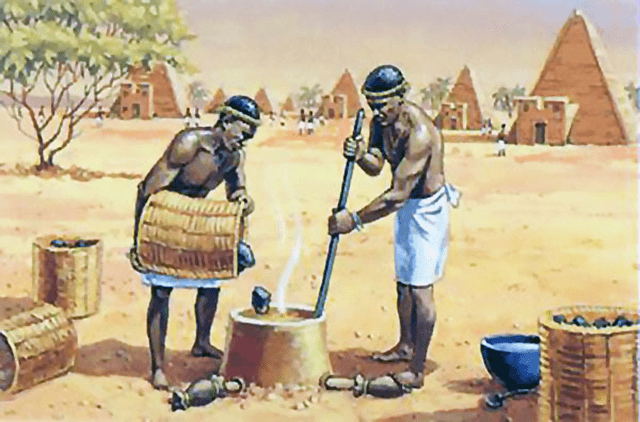
It was the period where the most common materials for making tools were iron ore. In most parts of Africa Iron Age is believed to have started during the first millennium A.D, some societies entered Iron Age early than others. The most famous iron sites in East Africa were discovered in Engaruka in rift valley in North Tanzania, other sites include Uvinza, Karagwe, and Ugweno in Same district. In Africa the most famous iron centers are Nok, Axum and Meroe,
Two theories are used to explain the discovery of iron
- Mistaken identity, the theory states that iron was discovered mistakenly when man mined iron instead of cooper,
- Fire forest theory, the theory suggests that the forest fire melted iron ore that were on the earth’s surface.
HOW IRON WAS PRODUCED.
Production of iron required preparation of Furness, specialized knowledge, selection and preparation of ores, preparation of fuel to control temperature,
ADVANTAGES OF DISCOVERY OF IRON
- iron technology revolutionize agriculture, man could clear large forest area for agriculture using iron axes and hoes, therefore there was more land under cultivation and increased food production,
- it contributed to economic specialization,
- the use of iron weapons and tools made it easier for communities to migrate,
- iron technology contributed to the development of trade as iron tools used as trade items,
- iron tools increased military operation and expansion of states and empires for example Mali empire, Buganda kingdom, Ghana empire among others,
- the discovery of iron helped people in East Africa to improve their tools,
- iron technology stimulated the development of towns, for example Meroe, Cairo Axum, and Nok,
- Iron helped man to master his environment.