Notes A
1. CRISES IN THE WORLD CAPITALIST SYSTEM
2. NATIONALISM AND THE STRUGGLE FOR INDEPENDENCE IN AFRICA
4. CHANGES IN POLITICAL, SOCIAL AND ECONOMIC POLICIES IN AFRICA AFTER INDEPENDENCE
5. THE NATIONAL MILITARY AND LEGAL INSTITUTIONS IN AFRICA AFTER INDEPENDENCE
6. FORCES HINDERING DEVELOPMENT IN INDEPENDENT AFRICAN STATES
7. AFRICA IN CONTINENTAL, REGIONAL AND INTERNATIONAL AFFAIRS
AMAZING
HISTORICAL SITES IN AFRICA – PART
4
10. Rock-hewn
churches of Lalībela
Lalībela, located in
north-central Ethiopia, is famous for its rock-hewn churches, which date
back to the late 12th and early 13th centuries. The 11 churches, important in
Ethiopian Christian tradition, were built during the reign of the Emperor Lalībela.
The churches are arranged in two main groups, connected by subterranean
passageways. Notable among the 11 churches are House of Medhane Alem (“Saviour
of the World”), the largest church; House of Golgotha, which contains
Lalībela’s tomb; and House of Mariam, which is noted for its frescoes.
Centuries after they were built, the churches still draw thousands of pilgrims
around important holy days.
11. Beit al-Ajaib
Museum, Zanzibar
The Beit al-Ajaib,
also known as the House of Wonders, is one of Zanzibar’s best known historical
landmarks located at the waterfront area of Zanzibar Town. The palace was built
in 1883 for Sultan Barghash on the site of an older palace used by Queen Fatuma,
the Mwinyi Mkuu (ruler of Zanzibar) in the 17th century. It was the first
building on Zanzibar to be installed with electric lighting, and one of the
first in east Africa to have an electric lift, earning the ‘house of wonders’
name by the locals. Since then, it has survived destruction from bombardment in
the 1800s due to a failed political coup and was used by the British and the
Tanzanian government as political headquarters. It has since been converted
into a museum, where visitors learn about Zanzibar’s rich history and culture
as well as about the history of the entire Swahili Coast, which extends from
Southern Somalia to Northern Mozambique. Entrance into the museum costs $3 and
photography inside the museum is permitted. Visitations can be booked through a
travel agency.
12. Leptis Magna –
Libya
The city was founded
by the Phoenicians in 7th Century BC, but was later expanded under the Roman
Empire’s control. The site was majorly excavated by the Italians in the 1930’s
and, it is the Roman architecture and influence that we can still see prominently
in the ruins of this abandoned city. As can be expected from former Roman
settlements, there are the classic amphitheatres, mosaics and bath houses.
Conflicts in Libya have halted tourists interest, but hopefully when the
country becomes a less high risk location it will bloom into being the tourist
hot spot it deserves.
MILITARY
COUPS IN AFRICA
Africa is not the
only space in the world where coups have happened. But Africa is currently home
to the highest number of countries with recent military coups and takeovers.
While the rest of the world is aiming for advancement and development, Africa is
battling recurrent news of military coups and takeovers. There is something
fundamentally wrong on the continent. While it is not out of place to blame the
role colonisation — and its resultant mambo-jumbling of people of differing
races, cultures, and approaches — has played in the disruption of the
continent, it is important to note that Africa is not the only home of former
colonies. India has never for once experienced a military coup. That is not to
say India is perfect, but India is growing, evolving and learning.
Coup attempts were
frequent in Africa in the post-independence and Cold War periods.
By comparison, the
past 20 or so years have been quiet. From 2011 through 2020, the continent
averaged fewer than one completed coup per year. But since then, the relative
stability has given way to what looks like a sharp reemergence of coup
attempts.
From January 1, 2020,
through December 2022, there were a dozen coup attempts on the continent. Of
those, six resulted in an unconstitutional change in government at the hands of
military officers.
With coups rampant
throughout the continent since 2011, the Union has lost its grip on peace.
Actors both local and international have exerted their influence over these
coups. Examples are the events in Libya, Egypt and Tunisia in 2011, Burkina
Faso in 2014 and 2022, Zimbabwe in 2017, Algeria and Sudan in 2019, Mali in
2020 and 2021, Guinea in 2021, Niger in 2023 and Gabon in 2023.
Unfortunately, the
governments that follow these coups have failed to address the circumstances
that caused them. This, of course, leads to further coups. Succeeding regimes
entrench themselves in power by corruption and by marginalising their political
adversaries. Eventually, rising mass poverty provokes deep political
disgruntlement. Political instability triggers a coup — and so the cycle
continues.
Foreign influence from the likes of France and the US play a significant role in the
instability in West Africa and the Sahel. Africa has hosted foreign
military personnel for decades. At least 13 countries, including the US,
France, UK, Germany, Italy, Belgium, Japan, and India, have a military
presence.
..
NATIONALISM AND DECOLONISATION OF AFRICA
Nationalism literally refers to the desire, love, or spirit of patriotism for ones’ nation. In Africa the term nationalism has been used to signify the struggle for independence or self-determination against foreign domination, since the coming of Europeans in Africa The effective resistances which Africans put up against European colonization for example those of the Ashanti people of Ghana, the Hehe of Tanganyika, or the Zulu of South Africa suggest a very strong sense of national identity and patriotism that African had for their societies and a fierce determination not to succumb to any other authority but their own.
In trying to demonstrate strong feelings of patriotism The king of the Yao people in Tanganyika had this to say to a German commander who had been sent to him to affirm the German colonial claim to his country in 1890: “I have listened to your words but can find no reason why I should obey you—I would rather die first. . . . If it should be friendship that you desire, then I am ready for it, today and always; but to be your subject, that I cannot be. . . . If it should be war you desire, then I am ready, but never to be your subject. . . . I do not fall at your feet, for you are God’s creature just as I am . . . I am Sultan here in my land. You are Sultan there in yours. Yet listen, I do not say to you that you should obey me; for I know that you are a free man. . . . As for me, I will not come to you, and if you are strong enough, then come and fetch me”.
The king of the Mossi people of Burkina Faso told a French captain: “I know the whites wish to kill me in order to take my country, and yet you claim that they will help me to organize my country. But I find my country good just as it is. I have no need of them. I know what is necessary for me and what I want. I have my own merchants. . . . Also consider yourself fortunate that I do not order your head to be cut off. Go away now, and above all, never come back”. The sentiments expressed by the kings and other African leaders of this kind demonstrate nothing but nationalism (feelings of patriotism.).
THE ORIGIN OF NATIONALISM IN AFRICA
The struggle for independence in Africa started soon after the introduction of colonial rule in Africa where by Africans organized their movements in ethnic basis to react against the imposition of colonial rule in their areas, it is argued that “without the partition and subsequent colonial rule in tropical Africa by Europeans powers there might have been no African nationalism.”
THE IMPORTANCE OF NATIONALISM IN AFRICA
- African nationalism helped Africans to regaining political sovereignty i.e. self-determination by opposing imperial occupation of the European colonialist.
- It helped to spread political awareness to African against white economic exploitation, like heavy taxation, land alienation and forced labor.
- It helped to bring various African ethnic groups to form unity and solidarity to fight for their independence, and this was to be achieved through formation of political parties.
- It removed the element of European capitalism and its related evils
- It helped to remove inferior complex among the Africans and helped Africans to appreciate the effort of liberating themselves from European domination
PHASES OF AFRICAN NATIONALISM
Nationalism in Africa is divided into three phase according to the period.
- Nationalism before 1945
- Nationalism after 1945 (mass nationalism)
- Nationalism after political independence
NATIONALISM BEFORE 1945
Nationalism struggles before 1945 was in form of individual tribes, ethnic groups, welfare association and independent church movements, nationalistic movement at this time aimed at fighting for equal right between Africans and Europeans in the colonial government hence the movements were reformist in nature. Some of these early resistances were for example Majimaji war of 1905-1907 against Germany in southern Tanganyika, Hehe resistance in 1891-1898 against Germany Nama and Herero resistance against British in central Africa, Nandi resistance in Kenya etc.
After the First World War 1919-1940s nationalism changed from ethnic and tribes bases to the formation of cooperative trade unions, social and welfare associations, and independent church movements. These associations were created by Africans who worked in various sectors of colonial system in order to remove colonial exploitation.
NATIONALISM AFTER 1945
After the Second World War nationalistic movements were in the form of political parties which acted as the vehicles of the nationalism struggle in Africa. These political parties were controlled by African elites who received colonial education, nationalistic movements at this time aimed at removing colonialist in Africa, and the nationalistic movement leaders used different approaches to fight for their independence basing on the nature of their colonial masters, for example some used armed struggle, other used revolution while other used constitutional means.
NATIONALISM AFTER POLITICAL INDEPENDENCE.
Nationalistic struggles at this time aimed at removing neo-colonialism, the movement is operating through the formation of regional integrations like AU, SADC, ECOWAS, EAC etc.
FACTORS FOR THE RISE OF MASS NATIONALISM IN AFRICA
Factors that gave birth to African nationalism are of two kinds.
- Internal factors
- External factors
INTERNAL FACTORS
These were forces that were internally motivated, that generated within African societies that brought about nationalism in Africa. Most of the internal factors were the results of contradictions which arose during colonial production like forced labor, land alienation, taxation, etc. These included the following factors.
- The roles of peasant cooperative union, especially in rural areas to defend the interests and welfare of the farmers, where some associations were formed by the colonialists as to speed up the production and the marketing of cash crop as well as sensitizing peasants about cultivation through their associations. But later alone developed nationalistic feelings and turned against the colonialists using their association’s structures in rural areas.
- The roles of independent churches, these were churches that were led by the Africans breaking away from main stream white churches to challenge their misdeeds over the Africans. They addressed not only religious but also social, political and economic grievances of Africans, such churches included Joseph Ejayi in west Africa, the Kikuyu native church, the watch tower church movement in Malawi 1906, the African national church in Tanganyika, the Tembu church in South Africa, the people God and religion of Jesus in Kenya and united native church in Cameroon. Such churches openly criticized the colonialists and encouraged their followers to fight them, some preached openly the principles of “Africa for Africans” the native church of Nigeria and the Cameroon said prayers for “freedom from imperialism”, this way stimulated radical nationalism of Africa.
- Formation of segregated African schools, after realizing that the missionary and colonial school taught nothing but European based syllabus some African societies begun their own schools, like among the Kikuyu in Kenya Africans were taught African syllabus. This helped in educating Africans and developing the spirit of nationalism.
- Rise of elites, who had attained colonial education like Mwal JK Nyerere in Tanganyika, Kwame Nkrumah in Ghana, Kamuzu Banda in Malawi and Abafemi Awolowo of Nigeria. The received education helped them to get used to the white language, to get exposed to various struggle and liberation of the world. But on top of that some elite came from outside Africa, the combination of both helped to the rise of nationalism, they provided leadership for nationalistic struggle as political parties’ leaders.
- Ghana independence in 1957, the independence of Ghana gave inspiration to militant Africans; it was like stimulant to other African countries to fight for their independence.
- The Italy vs. Ethiopia war of 1935-1941, under Mussolini and Haile Selasie and RasImra, increased the momentum of African nationalism, Italy an industrialized nation was heavily and bravery resisted by Ethiopia, this boosted African confidence towards their struggle for independence.
- Formation of social welfare association, this aimed to improve the working conditions of African workers, to remove discriminations and colonial abuses to the Africans such associations largely based in urban centers and comprised colonial civil servants like the Kikuyu central association in Kenya that was formed by Harry Thuku the railway territory civil association in Tanganyika, Tanganyika territory civil service association (T.T.C.S.A.) which was formed Martin Kayamba the peoples union in 1908 in Nigeria. Such association exerted more pressure on the colonialists to consider giving African independence which led to African nationalism.
- The roles played by Mass media especially newspapers played a big role in spreading awareness among the population in both rural and urban areas such newspaper included Sauti ya TANU in Tanganyika, the pilot and the comet in Nigeria
- The role of Colonial social infrastructures some historians do say that colonialism sown a seed of its own destruction, infrastructures like railway and roads facilitated the nationalistic activities in rural and urban centers by spreading the message of liberation in all parts of Africa.
- Formation of Pan-Africanism in 1900 by William Sylvester from the new world which later led to the formation of O.A.U. an organization that united all African independent nations to help in fighting for African independence
THE RISE OF SOCIAL AND WELFARE ASSOCIATIONS
Social and welfare associations are social groups associations formed by Africans to meet the immediate needs of members by protesting colonial exploitation, oppression and humiliations. They played an important role of providing political education to African communities by showing the evil of colonialism and the need to liberate themselves.
THE MAJOR GROUPS OF SOCIAL AND WELFARE ASSOCIATIONS
- The skilled and unskilled workers These comprised of elites both skilled and unskilled workers who lived in poor houses and had no sufficient health and education services compared to Asians and Europeans. They demanded better terms of services, equal provision of wages and salaries to workers of the same qualifications regardless of their race differences.
- African traders, These were petty traders in urban areas who were addressing their grievances including discriminations as African traders were discriminated while Asian and European traders were favored much by the colonial governments through provision of loans and other facilities.
- Peasants and cooperative societies. These were peasants cooperative unions aiming at defending the needs of the farmers since the colonial government confiscated their land and offered it to the white settlers while Africans possessed little land and forced them to live in infertile land. Examples of these associations were Kilimanjaro Native Planters Association of Tanganyika and Ukamba Members Associations of Kenya.
REASON FOR THE RISE OF SOCIAL AND WELFARE ASSOCIATIONS
- The influence of ex-soldiers from the first and second world wars, these were the Africans who were recruited by colonial governments to fight on their sides abroad these countries like Burma, Sri Lanka and other parts of the world. They created awareness to the Africans about the importance of welfare associations in the process of nationalism struggle.
- The role of African elites especially those trained by colonialists for the aim of assisting colonial administration in various fields like clerks, teachers, nurses among others. They mobilized their fellow workers to form social organizations within their working areas demanding good living and working conditions for workers as well as better salaries and wages as well as same benefits regardless their race differences.
- The increase of exploitation of human resources and natural resources, the world wars left European countries with economic difficulties as a result they decided to come to Africa to compensate their economic loss by exploiting African resource through land alienation, forced labor, taxation and payment of low wages this situation led the Africans to rise social and welfare associations to protest colonial exploitations.
- Awareness of civilized urban dwellers on colonial evils most Africans who settled in urban centers so the need to establish welfare associations especially among the people who originated from the same regions or clans, they later on provided such awareness to the African village dwellers who joined hands by supporting the establishment of social and welfare associations.
WEAKNESSES/PROBLEMS OF SOCIAL AND WELFARE ASSOCIATIONS
- It was based on small group’s organization like tribal or class as a result it was very difficult to for their grievances to be fulfilled by the colonial governments for they could not mobilize most of their countrymen.
- Frustration and fear among members due to colonial government harassments to members and leaders of social and welfare associations following this situation the members and leaders of the associations failed to stand firm for the interest of their associations. For example the Harry Thuku of the Kikuyu Central Association in Kenya was softened his stand against the colonial government after being exiled.
- Financial problems, most of social and welfare association faced the problem of inadequate funds this was due to the fact that they were depending income from their members’ subscriptions to meet their needs. Yet, their members earned low income and at the same time they had other obligations like tax payments and daily life needs as a result they contributed a small amounts in the association something that resulted to financial problems.
- Inadequate knowledge and skills of leaders in managements, many leaders of social and welfare associations had little knowledge and skills of managing offices and leading people this created difficulties in organization and mobilization of members within a given association.
- Banning of social and welfare associations by colonial government this was due to the fact that these associations were against colonial governments and administrations that is why colonial governments decided to ban them in order to abolish them. This situation made Africans to experience difficulties in organizing the associations.
STRENGTHS AND CONTRIBUTIONS OF SOCIAL AND WELFARE ASSOCIATIONS DURING THE STRUGGLE FOR AFRICAN INDEPENDENCE
- Establishment of infrastructures such as offices came to be used by the nationalist leaders during the struggle for independence.
- Preparation of nationalist leaders these associations prepared African nationalist leaders who were members of the associations through providing political awareness that made them to stand firm in struggling for African liberation. For example Jomo Kenyatta was a member of the Kikuyu Central Association who later on organized Kenyans to fight for their liberation.
- They provided awareness among the Africans on the evils of colonial governments, through these associations many Africans especially the members of the associations awakened on the injustice of colonialism. For example in Kenya the Ukambani experiencing demonstrations due to the increase of awareness.
- Journal publications, some social and welfare associations published their journals which carried out various political agenda and communicated with their members on different issues of their concern.
- They organized meetings which came to be a forum for airing their own grievances to the colonial rule.
THE RISE OF PROTEST AND RELIGIOUS MOVEMENTS
Protest can be referred as a reaction against those who mistreat or humiliate others, indicating that their treatment cannot be taken any more.
The African religious movements prevailed in the early 20th century among African communities. They took form of either indigenous protest movements like Msambwa Religious Movements in Kenya or the form of independent churches that had broken away from white missionaries churches.
African independent churches paved the way for African emancipation to occupy high ranks in the church hierarchy; previously Africans were at the bottom in the church as they only ended up being bible school teachers and catechists all high ranks and decision were made by white missionaries, the formation of independent churches made the Africans to accept Christianity as a religion not an aspect of colonial system as they thought to be when it was conducted by white missionaries.
Generally, the breaking away of African from various western missionary churches to independent churches was an expression of a protest against colonial domination in Africa.
CAUSES OF THE RISE OF PROTEST AND RELIGIOUS MOVEMENTS
- Church segregation, the European churches preached the salvation and equality of human being before God while Africans were segregated, oppressed and not allowed even to lead prayers they were taken as third citizens.
- The assistance of missionary to colonizers, the European churches also involved in helping colonizers in land alienation, forced labor, taxation and administration which had no any relation with the teaching of the bible. Africans realized that the European churches and colonialism were two sides of the same coin that the Christian missionaries were only to pave way for colonization process of Africa as many of them acquired labor farms and exploited African just like the white settlers.
- Missionaries advised Africans concerning political and economic problems by breaking their resistance e.g. through preaching biblical doctrines like the humble people are the blessed for them will enter the kingdom of God forgive those who wrong you.
- Missionaries intervened in African culture like girl circumcision among the kikuyu people in Kenya who vehemently detested the missionary activities. That prompted them to start independent schools and begun to spread.
- The Africans showed disapproval of missionaries’ education system, they considered it inadequate as it only taught African reading, writing and arithmetic (3Rs) this enabled African to occupy low position in colonial administration like clerks and wound dressers in the colonial government’s hospital.
- Africans wanted to counter attack the colonial exploitation and domination independent church campaigned against payment of taxes by African, racial discrimination, unequal provision of social services and forced labor.
WEAKNESSES/PROBLEMS FACED BY RELIGIOUS MOVEMENTS DURING THE STRUGGLE FOR INDEPENDENCE
- Financial problems the independent churches experienced in adequate funds because of depending on the little money rose from the few members of the churches that could not sustain most of their needs. For example the churches needed funds to support a large number of pupils expelled from mission schools in Kenya during the female circumcision controversy of the 1920s and 1930s.
- Conflicts among church leaders within independent churches there were several church leadership conflicts emerged among the church founders, since everyone demanded leadership recognition in the church.
- Competition between independent churches and the white missionary churches for followers, following this the white missionaries influenced many Africans to be converted into their churches by all means including provision of gifts like clothes and shoes for the aim of preventing African independent churches from getting followers.
- Lack of enough trained personnel as most of teachers in independent churches were untrained since most of them were ex-missionary school students with little western education and management skills.
STRENGTHS AND CONTRIBUTIONS OF PROTEST AND RELIGIOUS MOVEMENTS DURING THE STRUGGLE FOR INDEPENDENCE
- Establishment of African independent schools these schools enrolled African children only and they were taught their culture and evils of colonialism as a result later on they became political activists.
- Provision of reformism education, by teaching the Africans that the missionaries were mere agents of colonialism and practicing discrimination in the church and its hierarchy, following these missionaries was not fully evangelical as they preached thus reforms were inevitable.
- The increase of awareness among the Africans due to various protest including active demonstrations, boycotts and strikes especially when colonial governments used force to avoid protest. For example the religious protest in the Nyasaland under Chilembwe when suppressed made the movements to be popular.
- The religious movements and churches instructed Africans not to pay tax and not to be involved in the imperialist wars because Africans were not beneficiaries of these.
- They trained and groomed nationalist leaders in their churches, where they learned how to speak to the congregation, Jomo Kenyatta, J.K Nyerere, Kamuzu Banda, Milton Obote etc.
RISE OF MASS NATIONALISM AND POLITICAL PARTIES IN AFRICA
Mass nationalism this refers to nationalistic activities that occurred after 1945, after the Second World War it was in this period that African was successful in their struggle at times referred as modern nationalism.
Immediately after World War II Africans gained the momentum to demand for self-determination this came as a result for intensive exploitation of African resources after World war two.
Generally mass nationalism is characterized by mass feeling and attitude of demanding independence by using a nationalist struggle in form of unified parties beyond the class, tribe or ethnic background.
CHARACTERISTICS OF MASS NATIONALISM
- Well organized and planned by elites, African leaders those that were educated from colonial schools. e.g. J.K Nyerere, J.Kenyatta, M.Obote and K. Nkurumah
- It was a national wide that it covered the whole nation through opening up many branches in the whole state both in the rural and urban areas.
- It was political in origin, i.e. they struggled for political independence of Africa.
- It was dominated by both dialogue and armed struggle where dialogue proved a failure.
- It was motivated by both internal and external factors, unlike those before 1945 which were motivated by internal forces.
- It led to the independence of some nations i.e. it was successful in getting independence for African nations.
EXTERNAL FACTORS FOR AFRICAN NATIONALISM
These were factors that motivated nationalism but being generated from outside Africa such forces included:
- The returning ex-soldiers, who participated in the war on the side of their colonial masters assisting them as porters and security guards of many camps, this participation brought awareness since these soldiers were exposed to western democracy, freedom and liberation message some veterans like Dedan Kimathi who were later a leader of Mau Mau in Kenya.
- Formation of UNO in 1945, which replaced the League of Nation where independent African states were allowed to participate as members it becomes an organization of all nations. African and Asian nations through the UN opposed the colonialists and demanded self-determination, unlike during the League of Nations where African colonies became mandatory colonies of European nations.
- The India and Pakistan independences, these acted as external pressure for the Africans to emulate both were British colonies that attained their independence in 1948 as one nation which later separated in two nations, following that African quoted such incidences as a negotiate tool to argue for the independence.
- The Bandung conference of 17th April 1955, where Asians and Africans nations such as south Africa, Ghana, Nigeria, Libya and Egypt met in Indonesia to discuss their problems which include colonialism and economic development, they emphasized solidarity, it was during this conference that non-aligned movements NAM was formed.
- Rise of communism in USSR the second world war witnessed the expansion and consolidation of the communist bloc whereby Russian begun to provide material and moral support for anti-colonial struggle for Africa e.g. it supported rebel groups in Angola and Namibia to fight colonialists.
- The rise of USA as a leading capitalist nation, after the world war two US became the chief superior of war materials and the war did not affect her economy negatively made her to became a leading capitalist nation and begun to advocate for decolonization of African nations as a trick to compensate for not colonizing through establishment of neo colonialism to get market for her finished goods area of investment for her international cooperation, she supported decolonization through her open door policy and Marshal plan,
- Marshal plan, this was initiated by George Marshal the prime minister of USA whereby he began giving loans to the war ruined European nations on condition that they should decolonize in Africa and Asian nations, by granting independence to those nations.
- Open door policy of USA, this policy was introduced by USA for the aim of conducting business with independent African states thus it begun requesting colonialists to give independence to the African countries so as to do business with USA
- The British labor party, which assumed power in 1945 its policies were against colonialism which they viewed as oppression of humanity and wastage of British tax payers money such anti-colonial sentiments in Britain made many nationalistic movement to agitate for their immediate independence..
- The aftermath of the Second World War to the colonialists who incurred a lot of losses and could not continue with spending to the colonies so they were forced to grant some independence to some African states. But on top of the above some European powers adopted intensive exploitation to revamp their economies which awakened many Africans to resist thus the rise of nationalism in Africa.
WEAKNESSES OF POLITICAL PARTIES IN AFRICA
- Financial problems this was because members were unable to contribute the money required for various political activities due to poverty.
- Lack of reliable communication networks that could easy the transmission of information from one place to another in order to facilitate political activities of spreading political awareness among the Africans
- Colonial restrictions to political parties, colonial governments acted as obstacles to African political parties since they limited political activities and slow down the decolonization process by banning political parties. For example the British colonial government restricted government workers from being members of TANU in Tanganyika. In Ghana Kwame Nkrumah a leader of (CCP) was imprisoned, all of this aimed at suppressing African political parties.
- Opposition between African political parties as each party basing on their ethnic, regionalism or elitism competing against the other to the extent of conducting campaign against the other instead of joining hands in fighting their common enemy. For example in Nigeria and Uganda the cases were commonly practiced.
- Some political parties were created to meet the interest of a few such as elite for example the Uganda National Congress (UNC) was created to meet the interest of other non Baganda against the Kabaka Yekka of Buganda in Uganda.
- Lack of support from other organizations like women, youth and farmers associations, during the time of spreading liberation messages for decolonization process in Africa.
STRENGTHS AND CONTRIBUTION OF POLITICAL PARTIES IN AFRICA
- The use of peaceful means to fight for independence unlike armed struggle which led to loss of many African lives and property destructions
- The rise of awareness among Africans as many Africans through their different groups and associations became conscious of their grievances by demanding their independence from colonial governments through political rallies, propaganda newspapers and organized boycotts. For example CCP of Ghana encouraged Ghanaians to boycott the colonialists.
- Unifying the Africans to fight against colonial government as their common enemy, they used youth and women to unify the masses at the grassroots to fight colonialism. For example CCP of Ghana and TANU in Tanganyika had youths and women groups to support them in fighting their goals of bringing independence.
FORMS OF DECOLONIZATION IN AFRICA.
Forms of decolonization refer to the methods used by the Africans nationalist movement to win their independence from the colonialists.
Forms of liberation struggles in colonial Africa differed from one colony to another, partly because of the material condition and opportunities at hand obtained in such colonies, and partly because of the differences in nature of colonial powers and colonial economies played a crucial role in shaping the way the nationalist movement took place. The forms of decolonization can be categorized into three categories which are.
- Decolonization through constitution
- Decolonization through armed struggle
- Decolonization through revolution.
The application of these forms in African colonies was determined by the following factors.
- The nature of the colony, those colonies which were regarded as oversea provinces of colonial powers like British, French, and Portugal colonies regained their independence through armed struggle while colonies which were not regarded as oversea provinces like the British mandatory colonies regained their independence through constitution.
- The economic strength of the colony, in the colonies were development was very high and colonial investment was very huge like in South Africa, Zimbabwe, and Kenya, the colonialist were not ready to grant independence to the Africans in peaceful way, the only solution remained to Africans to apply forceful means.
- The financial economic position of the colonial powers, many colonies that belonged to Portugal applied armed struggle because Portugal economic position was not good, most depended on African colonies for domestic development so she was unwilling to grant independence.
- The status of the colony. Those colonies that were under the trusteeship of United Nations managed to achieve their independence through peaceful because of the pressure from UN and USA, but those which were not mandatory under the trusteeship of UN could not get independence so easily thus armed struggle.
- The nature of African reaction, those African societies which were more collaborative to the colonial powers in most cases dialogue means was used to decolonize. Example in Uganda centrally to those Africans who were not collaborative.
- DECOLONIZATION THROUGH CONSTITUTION
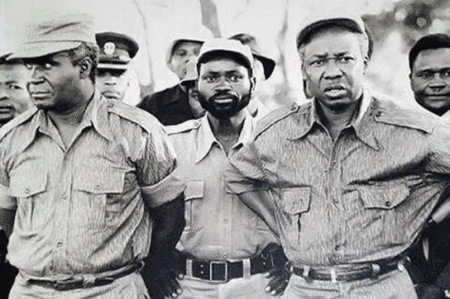
It involved the use of dialogue (negotiation, parliamentary means, petition etc) against the colonial state. It also involved the formation of political parties which were used to demands for African independence. These political parties were co-ordinated by political party leaders or elites like Kwame Nkrumah of Ghana, Leopord Sengor of Nigeria, Kened Kaunda of Uganda. J.K Nyerere of Tanganyika etc, this method was used mostly in colonies where colonialists were not very harsh and less exploitative.
REASONS FOR THE DECOLONIZATION THROUGH CONSTITUTIONAL MEANS
- Absence of many white settlers, in areas with no settlers like in Tanganyika and other parts of Africa they attained their independence through peaceful means; For example Tanganyika contained influential minorities of Europeans and Asians as the number involved was not large enough to bring obstacle in the path of national independence only 23,000 European among whom only few hundred could properly be regarded as settlers and the number of Asians was 87,000.Hence decolonization through constitutional means.
- Minimal problems like tribalism and religious differences; that would have brought internal disputes struggle or disunity. This was a sovereignty advantage to some African countries. For it was simple for them to unite the masses for self-determination.
- The trust ship colony a trust territory colony was subjected to measure of supervision by the United Nations a situation that made it impossible for the colonizers government to entirely pressure exerted by international opinion. For example Tanganyika was not mandatory like Uganda or Kenya it was under the trust ship of UN given to Britain as a result her independence was easily influenced by the United Nations.
- The role of political parties, where the political party which took over the power lacked serious opposition from other political parties which would have delayed the independence then the decolonization was through peaceful means. For example Tanganyika TANU was a major political party that had never been banned by the colonial government so it was able to operate freely without any hindrance unlike KANU in Kenya. This was very significant in achieving her goals of independence.
- The role of the leaders, where there were strong, approachable and democratic leaders with high sprite of patriotism for nation the independence was achieved through constitutional means. For example in Tanganyika the strong leadership of J.K. Nyerere and Oscar Kambona played a big role in achieving independence in Tanganyika by peaceful means.
- Absence of heavy colonial investment, in places where colonialists did not invest heavily in infrastructure or agriculture which they might have feared to lose the independence was through peaceful means.
DECOLONIZATION STRUGGLE IN GHANA.
Ghana was British colony, it began her nationalism struggles in 1868 after the formation of the Fante Confederation. In 1920 a modern political party “TheNational Congress of West Africa” was formed but with little success of independence. In 1940, another party called “United Gold Coast” was formed under J.B Danquar and Nkrumah as her general secretary.
In 1949 “convectional people’s party (CPP)” was formed under the leadership of Kwame Nkrumah. The CPP drew public support from rural and working class Ghanaians.
Under CPP led by Kwame Nkrumah Ghana was the first country in Africa to attain her political independence in 1957.
FACTORS FOR EARLY INDEPENDENCE IN GHANA THAN IN OTHER AFRICAN COUNTRIES.
- Lack of tribalism in Ghana, this played significance role in avoiding disunity in the struggle for independence.
- Ghana had no white settlers that would have been obstacle for the struggle of their independence thus the path for independence was smooth.
- The role of English language which many Ghanaians use as a symbol for unity against the colonialists.
- Strong leadership of Kwame Nkrumah, he devoted all her time and life for the national case, he used the idea of “independence now” to win public support.
- The role of external factors like the independence of India and Pakistan, and the rise of USSR in 1917 after Bolshevik revolution.
- Ghana had developed reasonable infrastructures that were used by many nationalists in carrying out their campaign reaching in every corner of the country.
- The role of CPP, it enjoyed overwhelming support in the cocoa growing because of her clear policies and implemental programs that would serve the people of Ghana. The party organized people in rural and urban areas to fight for independence.
THE ROLES OF GHANA INDEPENDENCE TO THE RISE OF NATIONALISM IN OTHER AFRICAN COUNTRIES.
The independence of Ghana in 1957 brought new impetus in the struggle for African. Ghana independence had a great influence on African nationalism in the following ways.
- Ghana became the headquarter of the ant-colonial groups of Africa following her independence, all issues pertaining independence in Africa was discussed in Accra Ghana.
- Ghana provided material support like man power and funds to many African nations which were fighting for independence from their colonial masters.
- Radio Accra in Ghana became the mouth piece of Africans to voice ant-colonial feelings and to mobilize support from inside and outside Africa.
- Kwame Nkrumah became the leader of pan Africanism and in 1958 pan Africanism conference was held in Ghana to discuss the way forward of African independence.
- Ghana became the model to other African countries to fight for independence, this made many African countries to go for vigorous campaigns for against colonialism and get sovereignty like that of Ghana.
- Nkrumah the president of Ghana after independence he held all African trade unions in 1959 with the aim to unity all African states into confederation, such an idea increased momentum for many Africans to fight for independence.
- Ghana as an independent country exerted more pressure on French domination on West Africa to stop their excess over the Africans which increased the Africans to demand for self-determination.