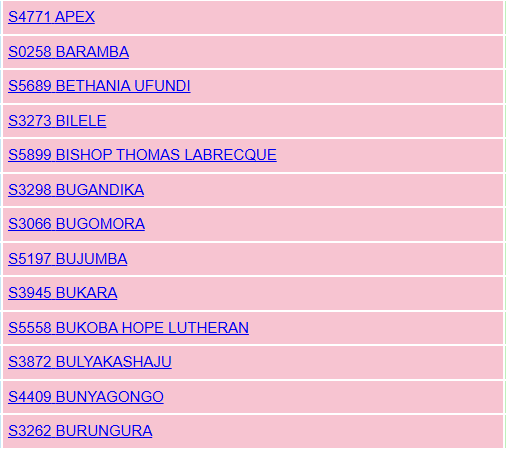
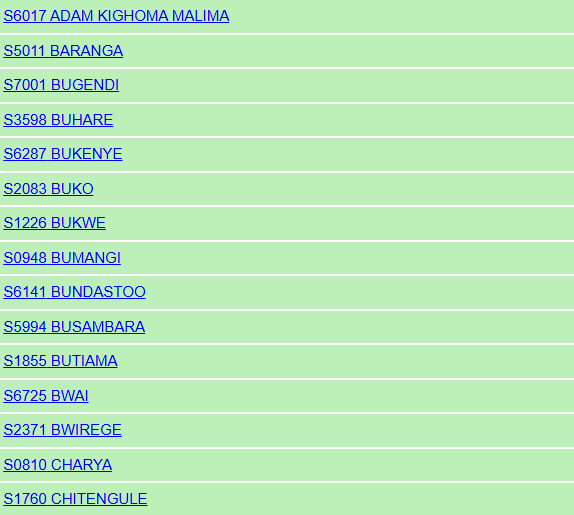
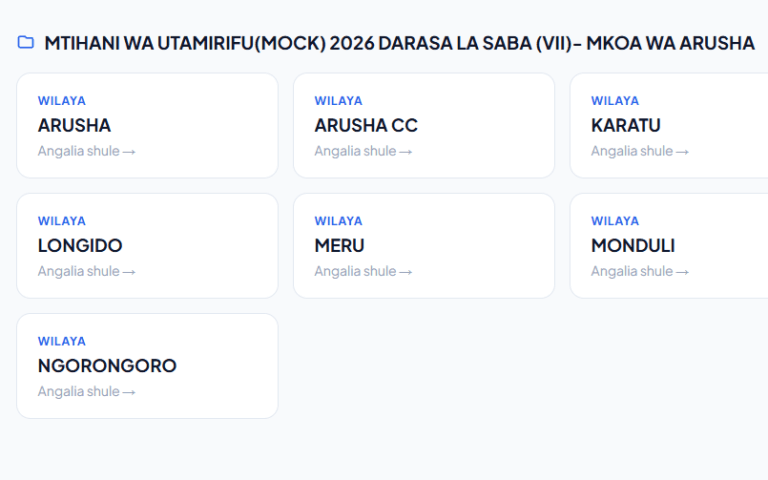
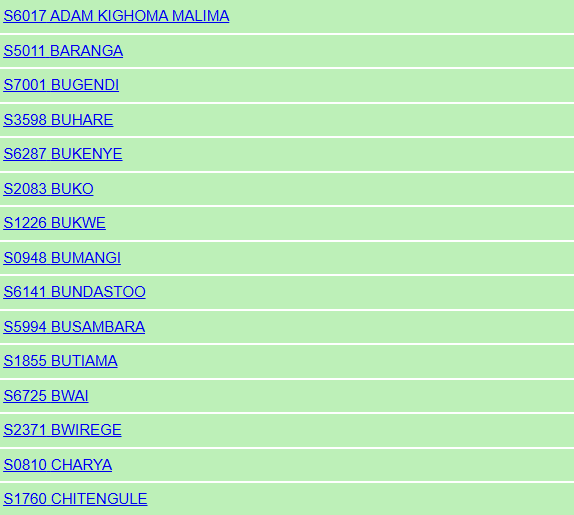
Matokeo ya Mock – LAKE ZONE – Form Four 2026 – Mikoa Yote | Shule Zote

Mock Results – Geita, Kagera, Mara, Mwanza, Shinyanga, Simiyu
Click the regions below to view the results
..
..
Identify problems and assess progress toward solutions. Schools must openly and objectively examine circumstances that are potentially dangerous for students and staff and situations where members of the school community feel threatened or intimidated. Safe schools continually assess progress by identifying problems and collecting information regarding progress toward solutions. Moreover, effective schools share this information with students, families and the community at large.
However, some contemporary psychologists give little support to the idea that there are general modes of thought particular to each stage. They consider that several types of evidence indicate that children do not go through general stages of development. This evidence includes the unevenness in children’s development, (e.g., in successfully completing various types of ‘conservation’ task); the existence of child prodigies with very advanced abilities in a particular domain (such as mathematics); and emerging evidence that familiarity with specific context and background knowledge are key factors in successful learning. Rather, these psychologists argue, children develop a sophisticated repertoire of task-specific (or domain-specific) skills and strategies on the basis of “associations” among many similar or related experiences.
In effect this is a form of complex “behaviourism”, which is the way we adapt to our environment. Some researchers argue that genetic pre-specification of domain-specific learning is too limited a concept to explain the flexibility of people’s actual learning behaviour within a domain. Karmiloff-Smith (1992) suggests that, rather than predetermined “modules”, there are innate predispositions which permit learners to develop better adapted domain-related “learning modules”, along constructivist lines.
Support students in making the transition to adult life and the workplace. Youth need assistance in planning their future and in developing skills that will result in success. For example, schools can provide students with community service opportunities, work-study programs and apprenticeships that help connect them to caring adults in the community. These relationships, when established early, foster in youth a sense of hope and security for the future.
Research has demonstrated repeatedly that school communities can do a great deal to prevent violence. Having in place a safe and responsive foundation helps all children – and it enables school communities to provide more efficient and effective services to students who need more support. The next step is to learn the early warning signs of a child who is troubled, so that effective interventions can be provided.