TOPIC 1 – CONCEPT OF GEOGRAPHY
TOPIC 2 – THE SOLAR SYSTEM
AMAZING GEOGRAPHICAL PLACES IN AFRICA – PART 1
1.
Mount Kilimanjaro, Tanzania
At
19,341 feet (5,895 meters) above sea level, Mount Kilimanjaro, a dormant
volcano, is Africa’s highest mountain and the highest free-standing mountain in
the world. The name ‘Kilimanjaro’ means ‘The Mountain of God’. But
to many, the mountain is simply referred to as “Kili.” Kilimanjaro actually
comprises three summits – Kibo, Mawenzi, and Shira. Kibo is the one that gets
all the photographic attention and forms the iconic backdrop to many
photographs of Mount Kilimanjaro National Park.
Its
gentle slopes mean that people can hike to the top. However, the lack of
difficult climbing does not change the effects of rapid altitude changes, and
it is common to develop altitude sickness while hiking to the top. From the
base to the summit, Kilimanjaro contains many vegetation zones, and a variety
of plants and animals can be seen which inhabit the zones.
2.
Table Mountain, South Africa
Table
Mountain, Afrikaans Tafelberg, flat-topped mountain in
southwestern South Africa, overlooking Cape Town and Table
Bay and dominating the northern end of the high, rocky Cape Peninsula. Its
tabular shape results from nearly horizontal layers
of sandstone exposed by vigorous wind and water erosion.
The distinctive-looking mountain is one of Cape Town’s most recognized
landmarks and is a popular tourist attraction that offers hiking, camping, and
other activities.
3.
Victoria Falls
This
spectacular Southern African waterfall, considered to be among the greatest in
the world, is located along the Zambezi River and straddles the
border between Zambia and Zimbabwe. The awe-inspiring nature of
the waterfall is in part due to its enormous width—more than 5,500 feet (1,700
meters). The waters plunge as far as some 355 feet (108 meters) down and drop
not into an open basin but into a dramatic-looking chasm. Victoria
Falls is known for its veil of mist visible from miles away; the name
given to the falls by an indigenous group is Mosi-oa-Tunya (“The Smoke That
Thunders”). Victoria Falls and the adjoining areas were collectively designated
a World Heritage site in 1989.
BENEFITS OF PLANTING TREES – PART 1
1.
The environment
Trees
help to combat global warming by absorbing carbon dioxide, removing and storing
carbon while releasing oxygen back into the air.
They
also reduce wind speeds and cool the air as they lose moisture and reflect heat
upwards from their leaves. It’s estimated that trees can reduce the temperature
in a city by up to 7°C.
Other
environmental benefits include the fact they help to prevent flooding and soil
erosion, by absorbing thousands of litres of stormwater.
2.
Carbon sequestration
Climate
change is one of the most pressing global issues, and reforestation plays a
crucial role in mitigating it. Trees are champions in absorbing carbon dioxide
(CO2) from the atmosphere through the process of photosynthesis—that’s why
forests are called carbon sinks. By planting trees and restoring forests, we
can effectively sequester carbon, reducing greenhouse gas emissions. As trees
mature, they continue to store carbon, making reforestation an impactful
strategy in combating climate impacts.
Trees
have an incredible capacity to absorb CO2. On average, a single mature tree can
absorb around 21 kilograms of carbon dioxide per year. Forest restoration
projects, spanning vast areas, can collectively sequester millions of tonnes of
carbon annually, contributing significantly to climate change mitigation.
3. Community & Social Value
Trees
are an important part of every community. Our streets, parks, playgrounds and
backyards are lined with trees that create a peaceful, aesthetically pleasing
environment. Trees increase our quality of life by bringing natural elements
and wildlife habitats into urban settings. We gather under the cool shade they
provide during outdoor activities with family and friends. Many neighbourhoods
are also the home of very old trees that serve as historic landmarks and a
great source of town pride.
Using
trees in cities to deflect the sunlight reduces the heat island effect caused
by pavement and commercial building
4.
Reducing Climate Change
If
people are good at something, then it is building up excess carbon dioxide in
the atmosphere. Harmful CO2 contributes to climate change, the biggest current
problem the world has to deal with. Trees, however, help fight it. They absorb
CO2 removing it from the air and storing it while releasing oxygen. Annually,
an acre of trees absorbs the amount of carbon dioxide equal to driving your car
26 000 miles. Trees are our main survival tools; only one tree can produce
enough oxygen for four people.
…….
Components of the Solar System
The solar system is made up of the Sun, planets, moons, natural satellites, asteroids, meteors, comets, dust, ice and interplanetary space (it contains interplanetary dust and interplanetary gas)
All planets and other bodies revolve around the Sun. The Sun is the central body of the solar system, and it is the only body that generates its own heat. Bodies that revolve around the Sun are kept in their orbits (paths) by the Sun’s powerful force of gravity
There are eight known planets in the solar system. The planets, starting from the one closest to the Sun are Mercury, Venus, Earth, Mars, Jupiter, Saturn, Uranus, and Neptune
The four innermost planets in the solar system known as terrestrial planets include Mercury, Venus, Earth and Mars. They are called terrestrial because they have a compact, rocky surface like the Earth’s
Jupiter, Saturn, Uranus, and Neptune are known as the Jovian (Jupiter-like) planets because they are all huge compared with Earth, and they have a gaseous nature like Jupiter’s. The Jovian planets are also referred to as the gas giants, although some or all of them might have small solid cores
You grew up learning that the solar system consists of nine planets, including Pluto as one as those planets. However, the International Astronomical Union (IAU) stripped Pluto of this status in 2006
When Pluto was discovered in 1930, it was hailed as the ninth planet in the solar system based on an overestimation of its size. But it looked not fitting among the larger planets following the discovery of swarms of ‘ice dwarfs’—icy rocks in the Kuiper Belt, at the very edge of the solar system billions of miles from the Sun. This prompted some astronomers to suggest that Pluto could be just another Kuiper Belt Object (KBO), disappointing generations of schoolchildren who grew up learning that Pluto was the smallest planet in the solar system
The importance of the components of solar system
Importance of the Components of Solar system
Although the solar system has many components, only the Earth and Sun are most important components of the solar system. This is because the Earth sustains lives of a diversity of living organisms (plants and animals). It contains numerous resources that enable living organisms to survive in it. The Earth’s atmosphere contains water and air that are used by living organisms for survival. In general, Earth is the only planet where both living and non-living organisms can be found. The Sun is the source of all energy that supports life on Earth. The Sun is supports water cycle and facilitates weather conditions and climate
The following are importance of the Sun
1. The Sun is very important for growth of the plants. The Sun helps the plants to make their own food by the photosynthesis process.
2. The Sun is very necessary for living organisms, as it provides us with light that enable us to do our work.
3. The Sun provides us with heat to warm our bodies.
4. The Sun provides food to some animals and humans (that feed on plants).
5. The Sun is the source of heat used in heating water, warming our bodies
6. The Sun is the source of solar energy used in our daily lives.
7. TheSunisimportantintheformationofrainfall.Forexample,theSunevaporatesthe water in the seas, lakes and oceans into water vapour. When the water vapourrisesinthesky,itcoolsandcondensesformingtheclouds,whicheventuallyformsrain.
The Sun
The Sun is a medium star. It is one of the millions of stars that you see at night in the sky. It looks much bigger because it is closer to the Earth than other stars. The Sun is much larger than the Earth, and much larger than all the other components of the solar system when put together. The Sun is the main source of energy that the planets receive. It is composed of different gasses; approximately 75% hydrogen, 23% helium, and 2% for all other elements. The Sun is so hot that nearly all molecules are broken into their separate atoms and all are mixed together into a single hot gas
Describe the characteristics of the Sun
The diameter of the Sun is 1.392 million kilometers. Its mass is approximately 330,000 times greater than that of the Earth. The Sun shines brightly because of its very high temperatures. The average surface temperature is 6,000 degrees Centigrade. It is much hotter in the interior where it is about 14 million degrees Centigrade
The Sun contains 99.85% of all the matter in the Solar System. The planets, which condensed out of the same disk of material that formed the Sun, contain only 0.135% of the mass of the solar system. Jupiter contains more than twice the matter of all the other planets combined. Satellites of the planets, comets, asteroids, meteoroids, and the interplanetary medium constitute the remaining 0.015%.
…………….
My name is Alex Oberle, and I am a National Geographic Society Fellow focusing on education. I’m here to talk to you about what geography is and how geographers think about the world. Geography is critical for understanding our increasingly interconnected planet, but what exactly is an interconnected planet?
Interconnections are the interactions between humans and the environment, both globally and on a local scale. For example, I live in Iowa, a great place to start thinking like a geographer because of interconnections between students and a wind farm behind their school. Wind turbines generate over a third of the electricity produced in Iowa, reducing the state’s contributions to global greenhouse gas emissions, all by harnessing this renewable resource. Locally, the wind towers provide an additional source of income for farmers. And regionally, wind energy related manufacturing jobs are vital for dozens of towns and small cities.
But the local and global benefits have a negative impact on birds and bats. Bats are particularly susceptible, and wind turbines are now the leading cause of mass mortality among bats. There is clearly a risk to local bat populations, but in thinking like a geographer, we see that it has regional and global interconnections too. Three of the bat species most vulnerable to wind turbines are bats that roost in trees, migrating when trees lose their leaves and fall. So a wind farm in Iowa may kill bats en route to Mexico or Guatemala, negatively affecting the ecology in those countries as well.
Let’s take a step back and ask ourselves what does a geographer want to know? It starts with three basic questions. Where is it? Why is it there? And why do we care?
Using our wind farm example, the wind turbines are located in Iowa. They’re there to reduce greenhouse gas emissions. And we care because wind energy has a local and regional economic impact and as a renewable energy source to address global climate change. Although wind turbines are generally positive for our planet, wind farms also pose a threat to species such as the tree roosting bats.
Geography contains a variety of perspectives. A perspective provides a frame of reference for asking and answering questions, identifying and solving problems and evaluating the consequences of alternative actions. The spatial perspective refers to the location where something occurs, as well as the interactions and interconnections among locations. Geographers also an employ an ecological perspective, which refers to the interaction of human disruption to the Earth’s physical environment.
Geographers analyze these positive and negative interconnected consequences so that we can learn from the effect of previous human actions and provide innovative solutions for the future. The beauty of geography is that all of this, knowing where something occurs and seeking to understand the significance of its interconnections, integrating the human and physical systems, caring about why something matters and taking informed action is all fundamental to exploration and the mindset of explorers.
This call to action is accessible to everyone from the student who’s looking out their school window at a wind farm in rural Iowa to National Geographic Explorers who use geography every single day. Explorer Sarah Parcak employs a spatial perspective by using satellite imagery to protect Egyptian archeological sites from looting. Enric Sala and the Pristine Seas Project similarly center on the spatial perspective by asking where are the last wild places in the ocean? Because human disturbances to ocean environments are critical to Sala’s project, his work naturally focuses on the interconnectivity of both physical and human systems. Both of these explorers’ work has had a positive, tangible impact, influencing policy decisions in Egypt and Mexico.
Geography is the ideal vehicle for National Geographic Explorers and student explorers alike to draw on the same mindset to identify and solve today’s pressing global issues. Thinking like a geographer empowers students to ask questions and develop a deeper understanding of their planet, enabling them to enact lasting change.
Transcripción (Español)
– Mi nombre es Alex Oberle, y soy un becario de la National Geographic Society enfocado en la educación. PIENSA COMO UN GEÓGRAFO Estoy aquí para hablarles sobre qué es la geografía y cómo los geógrafos piensan sobre el mundo. La geografía es fundamental para entender nuestro planeta cada vez más interconectado, pero ¿qué es exactamente un planeta interconectado?
Las interconexiones son las interacciones entre los humanos y el medio ambiente, tanto a nivel global como local. Por ejemplo, vivo en Iowa, un excelente lugar para empezar a pensar como geógrafo debido a las interconexiones entre los estudiantes y un parque eólico detrás de su escuela. Las turbinas eólicas generan más de un tercio de la electricidad producida en Iowa, reduciendo las contribuciones del estado a las emisiones globales de gases de efecto invernadero, todo aprovechando este recurso renovable. Localmente, las torres eólicas proporcionan una fuente adicional de ingresos para los agricultores. Y regionalmente, los trabajos de manufactura relacionados con la energía eólica son vitales para docenas de pueblos y pequeñas ciudades.
Pero los beneficios locales y globales tienen un impacto negativo en aves y murciélagos. Los murciélagos son particularmente susceptibles, y las turbinas eólicas son ahora la principal causa de mortalidad masiva entre los murciélagos. Claramente hay un riesgo para las poblaciones locales de murciélagos, pero al pensar como un geógrafo, vemos que también tiene interconexiones regionales y globales. Tres de las especies de murciélagos más vulnerables a las turbinas eólicas son murciélagos que se posan en árboles, migrando cuando los árboles pierden sus hojas y caen. Así que un parque eólico en Iowa puede matar murciélagos en ruta hacia México o Guatemala, afectando negativamente la ecología en esos países también.
Demos un paso atrás y preguntémonos ¿qué quiere saber un geógrafo? Comienza con tres preguntas básicas. ¿Dónde está? ¿Por qué está allí? ¿Y por qué nos importa?
Usando nuestro ejemplo de parque eólico, las turbinas eólicas están ubicadas en Iowa. Están allí para reducir las emisiones de gases de efecto invernadero. Y nos importa porque la energía eólica tiene un impacto económico local y regional y como fuente de energía renovable para abordar el cambio climático global. Aunque las turbinas eólicas son generalmente positivas para nuestro planeta, los parques eólicos también representan una amenaza para especies como los murciélagos que descansan en los árboles.
La geografía contiene una variedad de perspectivas. Una perspectiva proporciona un marco de referencia para formular y responder preguntas, identificar y resolver problemas, y evaluar las consecuencias de acciones alternativas. La perspectiva espacial se refiere al lugar donde ocurre algo, así como a las interacciones y conexiones entre ubicaciones. Los geógrafos también emplean una perspectiva ecológica, que se refiere a la interacción de la alteración humana con el entorno físico de la Tierra.
Los geógrafos analizan estas consecuencias interconectadas positivas y negativas para que podamos aprender del efecto de acciones humanas anteriores y proporcionar soluciones innovadoras para el futuro. La belleza de la geografía es que todo esto, saber dónde ocurre algo y buscar entender la importancia de sus interconexiones, integrando los sistemas humanos y físicos, preocupándose por por qué algo importa y tomando acciones informadas es fundamental para la exploración y la mentalidad de los exploradores.
Esta llamada a la acción es accesible para todos desde el estudiante que mira por la ventana de su escuela hacia un parque eólico en la zona rural de Iowa hasta los exploradores de National Geographic que usan la geografía todos los días. La exploradora Sarah Parcak emplea una perspectiva espacial utilizando imágenes satelitales para proteger los sitios arqueológicos egipcios del saqueo. Enric Sala y el Proyecto Pristine Seas también se centran en la perspectiva espacial al preguntar dónde están los últimos lugares salvajes en el océano. Porque las perturbaciones humanas en los entornos oceánicos son críticas para el proyecto de Sala, su trabajo naturalmente se centra en la interconectividad de ambos sistemas físicos y humanos. El trabajo de ambos exploradores ha tenido un impacto positivo y tangible, influyendo en decisiones políticas en Egipto y México.
La geografía es el vehículo ideal para los exploradores de National Geographic y los estudiantes exploradores por igual, para aprovechar la misma mentalidad para identificar y resolver los problemas globales urgentes de hoy. Pensar como un geógrafo empodera a los estudiantes para hacer preguntas y desarrollar una comprensión más profunda de su planeta, permitiéndoles realizar cambios duraderos.
………..
Benefits of studying geography
Varied academic knowledge
Studying geography at university means you will gain a wide variety of knowledge that encompasses different subject areas. Although you will primarily be learning about human and physical geography, you will also be touching on history, economic, cultural, social and science subjects. You will gain a varied knowledge that will allow you to keep your options open in regards to any further studies you want to pursue or the career you want to follow.
Shape the direction of your degree
Geography degrees, such as those at Durham University, typically offer a variety of optional modules for you to choose from, both at undergraduate and postgraduate level. From the first year of your undergraduate geography degree, you will be able to start personalising your degree and what areas you want to specialise in, whether you want to learn more about the pressures on the planet or earth’s principles, the choice is yours.
Postgraduate degrees also offer optional modules, but you will typically already be following a specialism from the course you choose to study.
Highly desirable transferable skills
Alongside the varied knowledge you will learn, you will also develop a range of transferable skills that are highly desirable by potential employers. Many degrees help you develop transferable skills, but geography gives you a broad range of skills that will help you in any career path you choose to follow. Some examples of the skills you will develop with a geography degree include:
- Teamwork
- Problem-solving
- Advanced analytical skills
- Communication
- Data evaluation
- Data collection
- Planning
- Creative thinking
- Time management
- Self-motivation and self-reliance
- Report writing and data presentation
- Adaptability
Broad choice of future careers
Thanks to the transferable skills and academic knowledge you gain from studying geography at university, you will have an abundance of career paths to choose from. If you want to pursue a career directly related to your degree you could go on to become a cartographer, environmental manager, town planner or a secondary school teacher to name a few. Other careers you could look at pursuing include astronomer, landscape architect, international aid worker or meteorologist.
You could look at working in the private or public sector, or for a charity or non-governmental organisation and work in industries such as property, environmental, international development, military, business and engineering as a few examples.
Geography is a highly employable degree, with 89% of Durham University geography graduates securing employment or going on to further study within six months of graduating (Destinations of Leavers from Higher Education 2016/17).
Gain practical experience with fieldwork
Geography degrees give you the opportunity to put what you learn into practice before you graduate. You’ll have the opportunity to take part in fieldwork to enhance your studies – as well as conducting your own, related to what you’re interested in. Fieldwork is an excellent tool that allows you to gain practical real-world experiences, develop new skills and immerse yourself in your studies.
Prepare for an international career
Students that study geography tend to be more open-minded and show a clear interest in the world. You will typically have international opportunities throughout your degree. At Durham University, you have the option to conduct fieldwork abroad, which will help you experience other cultures and environments to help expand your global perspective. Alongside this and your academic knowledge, transferable skills and world view, you will be highly prepared for an international career and will stand out in the global employment market.
Make a difference
Graduating with a geography degree means you know about climate change, the environment, sustainability, urban regeneration, human rights, natural disasters, energy and international relations – topics which are becoming more and more important in recent times. With this knowledge, you could pursue a career that can make a difference to human life, whether it’s helping combat global warming, pushing ahead with urban renewal or identifying when a natural disaster may occur.
What makes Geography at Durham great?
……….
Postgraduate opportunities
Another reason why we study geography is the choice of postgraduate degrees available to you. With the varied knowledge and skills you will develop, you could apply to study a Masters degree in a range of different subject areas. You could continue to develop your geography knowledge, honing your skillset and interests to specialise in a specific area by studying a degree such as MA Risk (offered at Durham University). Alternatively, you could study a masters research degree.
Or you could study a postgraduate course in an area such as teaching, landscape architecture or even business to take your future career in a different or more specific direction.
Study geography at university in the UK
If you want to study geography at university in the UK then Durham University International Study Centre can help you get there. By studying one of our pathway programmes, such as the International Foundation Year or Pre-Masters Programme, you can develop the skills, academic knowledge and your English language ability to meet the requirements to study at Durham University.
Frequently asked questions
How to study geography in uk?
To study a geography degree in the UK you need to make sure you are prepared for the UK education system. As well as a keen interest in geography or a related area, you will need to make sure you have the grades for your chosen university. A pathway programme can help you meet the English language entry requirements of the university you choose.
Where is the best place to study geography in the UK?
The university you choose will be personal to you. Read the course descriptions of the different universities you’re considering and see which one interests you the most. Also consider what type of university you want to study in – would you prefer a city or campus university? Do you want the opportunity to study abroad during your degree? All these things will help you make the right choice
What can you do with a geography degree?
If you have a passion for geography, a degree in the subject can help you get a career in the area. Many geography degrees include practical work experience allowing you to discover the area of work which suits you best. Careers include cartographer, environmental manager, town planner and more. And if you decide that a geography-related career isn’t for you, a geography degree also equips you with a range of transferable soft skills such as problem solving and data analysing that will work well in any career.
………
The Earth is in motion all the time. People cannot feel this motion because, like all other planets, they move with it. There are two types of movements of the Earth.
Describe the types of earth’s movements.
There are two types of movements of the Earth, namely
1. The rotation of the Earth on its own axis.
2. The revolution of the Earth a round the Sun
Describe the term rotation.
Rotation refers to the spinning of a body on its axis. The Earth rotates or spins on its axis in an anti-clockwise direction, from West to East through 360 degrees. It makes one complete rotation in 24 hours. Thus, for every 15 degrees of rotation, the Earth takes one hour which is the same as four minutes for every 1 degree
An axis is an imaginary line joining the North (N) and South (S) poles through the centre of the Earth. The rotation of the Earth is very rapid although it is difficult to feel its motion. At the equator, every point of the Earth’s surface is travelling eastwards at about 1600 km per hour. At latitude 40 degrees, the speed is about 1280 km per hour
The Earth’s axis makes an angle of 66 ½ degrees with the plane of its orbit. In other words, the axis is tilted 23 ½ degrees from the perpendicular
Evidence to prove that the earth rotates.
The following observations illustrate that the Earth rotates from West to East The following observations illustrate that the Earth rotates from West to East
1. When travelling in a fast-moving vehicle, you notice that trees and other objects on both sides of the road are moving fast in the opposite direction. This observation is similar to the movement of the Earth in relation to the Sun.
2. At night most of the stars appear to move across the sky from West to East. This observation shows that the point of observation (Earth) is moving from West to East
3. Sunrise and Sunset: the Sun rises over the eastern horizon in the morning and sets over the western horizon in the evening. But since the Sun is in the Centre of the solar system and the fact that it does not move, this shows that the point of observation (the Earth) is moving by rotation from West to East
4. Day and Night: During the Earth’s rotations some regions face the Sun while others do not face it. The regions facing the Sun experience day time whereas the regions which are not facing the Sun are in darkness (night). If the Earth is not rotating, one half of the Earth would be having daylight while the other half would be in total darkness forever. The occurrence of day and night proves that the Earth is rotating
5. Photographs of the Earth taken from the satellite at different times of the day show that different parts of the Earth experience daylight at different times
6. If the Earth is not rotating, different photographs taken at any time of the day would all look alike
The rotation of the Earth is very important because it causes the following phenomena
1. Alternation of day and night: Rotation of the Earth causes the side of the Earth which face the Sun to experience daylight, which is the day, whereas the side that is not facing the Sun at that time will be in darkness (night). This ensures that, at any time of the day, one half of the Earth is in darkness and the other is in daylight. If the Earth did not rotate then one half of it would be in daylight while the other half would be in darkness all the time (Figure2.9)
2. The occurrence of tides: Tides are the periodic rise and fall of sea levels caused by the combined effects of the gravitational forces exerted by the moon and the Sun on the rotating Earth
3. Time difference between longitudes: The rotation is causes the difference in time between different places on the Earth. It causes the difference of one hour in every 15degree interval between longitudes, which is equivalent to 4 minutes for each degree of longitude
4. Deflection of winds and ocean currents: As the Earth rotates on its axis from West to East, winds and ocean currents flowing over the Earth’s surface are deflected. The anticlockwise rotation of the Earth deflects prevailing winds to the right in the northern hemisphere and to the left in the southern hemisphere
Define the term revolution.
In Geography and Astronomy, the word revolution is defined as the motion of one body around another. The Earth revolves around the Sun while the moon revolves around the Earth.
Explain the process of revolution.
The Earth is at aphelion each year on 4th July, when it is at the maximum distance of 152 million kilometers from the Sun. The Earth is at perihelion each year on 3rd January when it is at the minimum distance of 147 million kilometers (Figure 2.11)
The Earth’s revolution around the Sun takes a year (365¼ days). Therefore, the average speed of revolution is about 29.6 kilometers per second. A normal year has only 365 days. The remaining fraction of ¼ day is added once in four years to make a leap year of 366 days.
The results of the Earth’s revolution around the sun
The revolution of the Earth around the Sun and the inclination (tilting) of its axis results in the following
1. The four seasons of the year, namely summer, autumn, winter and spring
2. Changes in the position of the midday Sun at different times of the year
3. It causes varying lengths of the day and night at different times of the year. The axis of the Earth is inclined to its elliptical plane at an angle of 66.5 degrees. If the axis of the Earth was vertical, the Sun rays would always be overhead at the Equator, thus all places on the Earth would always experience 12 hours of daylight (day) and 12 hours of darkness (night).
4. The eclipses (Eclipse of the Sun and eclipse of the moon).
Four Seasons
Because of the inclination of the Earth’s axis to the orbital plane, the angle at which the Sun rays shrike the Earth’s surface varies. This leads to seasonal changes which are mainly experienced in the high and mid-latitude regions. This results in four distinct seasons namely, spring, summer, autumn and winter.
Change in the Position of the Midday Sun
Because of the inclination of the Earths’ axis, the midday Sun is directly overhead at the Tropic of Cancer on 21st June; and at the Tropic of Capricorn on 22nd December. This is called the solstice. On 21st June, it is winter solstice in the southern hemisphere and summer solstice in the northern hemisphere. On 22nd December, it is winter solstice in the northern hemisphere and summer solstice in the southern hemisphere. On 21st March and 23rd September, the midday Sun is directly overhead at the Equator. These are the only two days in the year when all places on Earth have almost equal hours of day and night. This is known as the equinox.
Table 2.2 shows dates on which the Sun is vertically overhead at the Tropic of Cancer, Tropic of Capricorn and the Equator. The resulting seasons are also indicated
Varying Lengths of Day and Night
Not all places across the Earth experience the same lengths of day and night. Some places receive long hours of daylight than darkness while others receive long hours of darkness than daylight. This is because the Earth’s axis is inclined at 66 ½ degrees to the orbital plane (23 ½ degrees to the perpendicular). The Earth remains permanently inclined at this angle as it revolves around the Sun
If the Earth’s axis was perpendicular to its orbital plane, all places on the Earth’s surface would have equal days of daylight and darkness throughout the year. In December, it is winter in the southern hemisphere and the hours of darkness increase steadily. The further away a place is from the equator, the longer the nights. Usually, beyond the Arctic Circle which is 66½ degrees North towards the North Pole the number of days of complete darkness increases. The North Pole is in complete darkness for half a year.
Eclipses
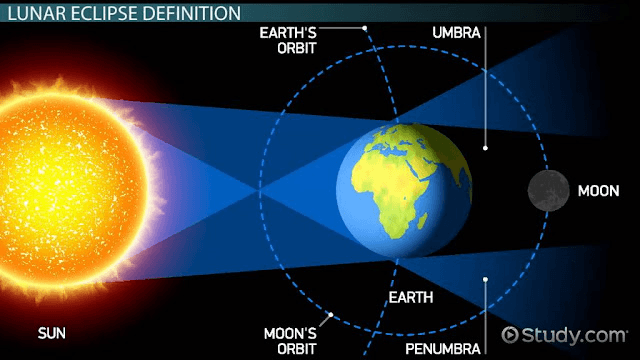
Eclipse refers to the partial or complete obscuring of one celestial (heavily) body by another. An eclipse occurs when one celestial body moves in between another heavily body and its source of light (the Sun). Eclipses normally occur when the Sun or moon is obscured from the view for a short period. This means that an eclipse will only occur when the Sun, moon and Earth are in a straight or nearly straight line.
The question is how the eclipses related to the revolution of the Earth? The answer is that as the Earth revolves around the Sun and the moon revolves around the Earth, there comes a time when the moon and the Earth are in a straight line. As a result, an eclipse of the moon (lunar eclipse) or the Sun (solar eclipse) occurs, depending on which body (the Earth or the moon) causes an obstruction
Lunar eclipse
This eclipse occurs when the Earth passes between the moon and the Sun and the Earth’s shadow falls on the moon
Solar eclipse
A solar eclipse occurs when the Moon passes between the Earth and the Sun, thus casting its shadow onto the Earth. In this type of eclipse, the Moon fully or partially blocks the Sun, leading to total or partial eclipse respectively