IMPORTANT SKILLS FOR STUDENTS
1.
Problem Solving
The
world has changed drastically, and it will continue to do so. As a student,
you’ll be working on problems you haven’t even thought about yet. You’ll need
the ability to identify an issue, create a workable solution, and implement it
successfully. Problem-solving abilities will enable you to do everything from
write your grocery list to develop and realize your ambitions.
2.
Digital-age literacy
“The illiterate of the 21st century will not be those who cannot read and
write, but those who cannot learn, unlearn, and relearn.” – Alvin Toffler.
When
it comes to information, the sheer quantity thereof stored in one’s head, and
the way it got there, are no longer all that important – what matters is what
you do with it. This means that in order to become successful, students need to
be able to analyze, access, manage, integrate, evaluate and create information
in different media, which implies information
and media literacy.
3.
Hones Leadership Skills
The
next advantage that proves the importance of skill development in education is
the support given to develop leadership qualities. In the words of a leading
stakeholder, skill education or skill-based education creates impeccable
opportunities to build leadership qualities in students. It helps students to
the art of active listening, teaches them how to be organized, and inspires
them to be good team players.
……….
A Nation can be defined as a large group or community of people living in a defined geographical area and sharing a common history, culture and language under one government. Examples of nations include Tanzania, Japan, Zimbabwe, India and Uganda. A nation should be recognized by other nations as a sovereign state and should be free to decide and implement its own policies. It should not be part of another nation nor should it be under the control of another nation.
The Components of our Nation
The Components that Make up our Nation
To be able to analyse the components that make up our nation
For any nation to be recognized as a nation it must have the following components: Sovereignty, People, culture, boundaries and government
Sovereignty
The word “Sovereignty” comes from the Latin word “superanus”, which means “supreme”. Therefore, Sovereignty refers to the supreme power exercised by a nation to control all individuals and associations within its territory.
Sovereignty can also be defined as the highest power which belongs to the people. National sovereignty means that a nation is free to decide and implement its decisions without being interfered with by any external forces from other nations. A nation should be able to run its political, economic and social matters independently.
Importance of National sovereignty
National sovereignty is important because it maintains good relations with other nations through promoting good foreign policies on matters concerning other nations.
It helps maintain peace and security of a nation through execution of national laws, rules and regulations to prevent civil wars and conflicts with other nations.
It brings about national stability and encourages investors to invest in a country because a national is free to establish policies that will encourage local and foreign investors to invest in the country.
Citizens are free from being dominated by other nations because of non-interference in the control of the nation by other countries.
Hindrances to national sovereignty
Poverty, This is the inability to afford basic needs like food, shelter and clothing which is the main problem faced in many African countries whereby most are economically poor. This results in African countries depending on developed countries for help through grants and aid which create conditions that violate the sovereignty of some African countries.
Civil wars, The fighting between ethnic groups within the same nation can affect the freedom of the nation because when the nation fails to maintain peace and security within the nation, United Nations will intervene to protect human rights.
Natural hazards, Disasters such as floods, earthquakes and volcanic eruption undermine the economies of poor countries which in turn hinders national sovereignty since the government cannot depend on its own capabilities and needs to ask for assistance from other countries through aid.
Population
Population is the number of people living in a particular defined area. According to the 2010 population survey report, Tanzania has over 40 million people. More than 80% of Tanzania’s population lives in rural areas. Tanzania mainland has over 125 ethnic groups. Kiswahili is the common language and the largest population group is Bantu who occupy approximately two-thirds of the country and are divided into many tribes. Within the population is where we can find leaders, citizens and the army which protects the country and builds up a strong nation.
Boundaries
National boundaries are the dividing lines between the area belonging to Tanzania and the area belonging to her neighboring countries. Tanzania was formed on the 26th April 1964. On that day, Tanganyika and Zanzibar united to form thecountry currently known asTanzania. Our country Tanzania covers a total area of 945,202 square kilometersand is bordered by man-made and natural boundaries. Natural boundaries of Tanzania includethe Indian Ocean to the East, Mount Kilimanjaro to the North, Ruvuma River to the South, Lake Nyasa to the south west, and Lake Victoria to the North and Lake Tanganyika to the West.
Tanzania is bordered by eight nations, namely Kenya and Uganda to the North, Rwanda, Burundi and Democratic Republic of Congo to the West, Mozambique to the South, Malawi and Zambia to the South West. The Indian Ocean borders Tanzanian’s Eastern side. The islands of Zanzibar and Pemba lie along the coast of Tanzania Mainland.
The Government
The government is an administrative organ of the state. It consists of elected and selected groups of people who are responsible for controlling and maintaining the laws and orders of a country. The state has three organs which assist each other in fulfilling its functions. These organs are:
- The Executive:The Executive is the main branch of the central government and comprises of the president, the cabinet, civil servants and armed forces. The Executive is responsible for administering various activities of the government.
- Judiciary:This organ functions to interpret the laws and make rulings over disputes in the state.
- Legislatureis the law making body of the state. It is the state organ whose members are elected to represent different constituencies. Some of them are appointed. Legislature is also called parliament and is comprised of the President and the National Assembly. The President is part of the parliament but not a member of the parliament. This is because the president does not participate in parliamentary discussions but participates in the process of making laws by signing the bills to become laws.
Culture
Refers to the customs and beliefs of a particular group of people. It also includes the people`s way of life and social organization.
Exercise 1
Answer the following questions
- In your own words, explain what you understand by the term Nation and give five examples of the nations you know apart from the examples given above.
- Suggest five solutions to protect national sovereignty.
- Draw the map of Tanzania and show its national boundaries.
- Why is the President of the United Republic of Tanzania said to be part of the parliament but not the member of it in the national assembly?
- List five national components.
……………
What is a national symbol?
A symbol is a sign that represents something. National symbols are signs which represent a nation. These symbols are very important as they serve as a reminder of our nationhood to us and to the rest of the world; they promote our culture and remind us about events that have taken place in our nation. Tanzania has several symbols; these include tangible things like money, flags and the coat of arms,as well as intangible things like the national anthem and language.
The following are the major national symbols in Tanzania:
- The national flag
- Presidential standard
- The coat of arms
- National Anthem
- Uhuru Torch
- National currency
- National Language
- The national Constitution
- National festivals (holidays) in Tanzania
The Significance of each National Symbol
Explain the significance of each national symbol
The national flag
A national flag is a piece of cloth with a special color design. The national flag of Tanganyika was hoisted for the first time on the 9th December, 1961 and that of the United Republic of Tanzania was hoisted for the first time on the 26th April 1964, when Tanganyika and Zanzibar united to form Tanzania. The main function of the national Flag is to show that Tanzania is a completely independent and sovereign nation. Our Flag has four colors; Green, Yellow, Black and Blue.
- Greenrepresents the land and vegetation of Tanzania
- Bluerepresents the ocean and other water bodies found in the country
- Blackrepresents the people of Tanzania
- Yellowrepresent the natural wealth of Tanzania, like minerals
Importance of national flag
- It is a symbol of our independence/sovereignty
- It is a symbol of freedom and unity of the people
- The National flag is also a symbol of the nationality and a symbol of Tanzania culture
Presidential standard
The presidential standard is a flag which is used during official ceremonies where the president is in attendance. It has a green background with a blue and the coat of arms in the middle. The coat of arms on the presidential standard has no crops, human figure or the peak of Mount Kilimanjaro.
The coat of arms
The coat of arms is an official seal or stamp of the government which comprises different colors and landmarks of Tanzania. It act as national badge and, therefore, all government publications bear this official seal. Our coat of arms has twelve components. These components represent various national interests such as state power, economic bases, national culture and history.
Compositions of the coat of arms
The coat of arms comprises of the following things:
- Two human figures– The man and the woman represent the people of Tanzania. The two figures also symbolize the need for cooperation between men and women in order to bring about development.
- Two elephant tusks– These represent our national heritage in terms of wildlife. Tanzania has beautiful national parks and game reserves in which different animals and plants are found in their natural habitats.
- Shield and spears– They represent weapons that were used by Tanzanians to resist colonialism. These weapons represent the readiness of the people to defend their independence
- Golden band on the upper part of the shield– This represent the mineral wealth of the country
- Uhuru Torch– It symbolizes freedom, enlightenment, knowledge and prosperity.
- National Flag–It represent our sovereignty.
- Red band on the shield– this represent the fertile red soil found in our country
- Crossed Axe and hoe– These represent the tools which Tanzanians use to develop their country.
- Sea waves– These represent water bodies found in Tanzania. Approximately 62,000Km square of Tanzanian`s total area is made up of water bodies. This includes the Indian Ocean, rivers, lakes and swamps.
- Peak of mount Kilimanjaro– This is the highest mount in Tanzania and Africa in general which represents attractive geomorphological features.
- Crops (cotton and gloves)– At the feet of the man there is a branch of a glove tree. At the feet of the women there is the branch of cotton plant which stands for the cash crops produced in Tanzania.
- The wards “Uhuru na Umoja”which means freedom and unity express the belief that, Tanzanian`s strength depends on people`s solidarity.
Importance of the coat of arms
- It is used as the symbol of the authority and official government seal.
- It symbolizes our national culture and history.
- It symbolizes state power.
National Anthem
This is the official song which reflects people’s national feelings, desire, glory and pride in their nationality. The Tanzanian national anthem is sung during important national occasions such as when a special announcement is made by the president; when foreign heads of states visit our country; When the president or the vice president and the prime minister visit another country officially, and when our national teams are playing against teams of other countries; before and after the president addresses the nation; and when the national flag is hoisted.
Importance of the national anthem
It is a symbol of our nationality , freedom and it unifies Tanzanians
It makes citizens feel proud of their country
National anthem expresses a sense of belonging to Tanzania and Africa
It identifies Tanzania outside the country.
Uhuru Torch
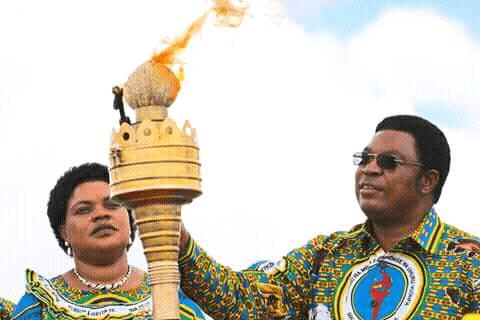
This is the touch of freedom which also known as independence touch introduced by the first president of Tanzania Mwl. J.K.Nyerere as a symbol of freedom, unity, love, dignity, solidarity and hope among Tanzanians. It was first lit on top of Mount Kilimanjaro at midnight on 9th December 1961. This was the day Tanganyika got independence from Britain.
Importance of Uhuru Torch
- It symbolizes freedom and light
- It promotes unity in the country
- It also promotes peace, dignity, respect and hope among Tanzanians
- It promotes co-operation among Tanzanians and development in aspects of life
The Uhuru Torch
National currency
Is the system of money that a country uses. Our national currency is the Tanzanian shilling. Currency is also called money. Money is used for measuring value, trading and paying for goods and services in a country. Tanzania money is the form of notes and coins.
Importance of national currency
- It acts as a medium of exchange in trade transactions that is selling and buying of goods and services in the country
- It is used to measure value and identify the nationality and freedom of a nation
- It is the means of settling debts.
National Language
This is the language spoken by all the people within a country. The national language of Tanzania is Swahili.
Importance of the national language
- The national language acts as the media of communication within a county.
- It symbolizes the culture of the nation concerned which is Tanzania
- It unifies people with a common history.
- It also identifies the country internationally
The National Constitution
A national constitution is the system of laws and principles by which the nation is governed by. A constitution provides guidelines which society must follow. Our country Tanzania is ruled according to the constitution that was enacted 1977. Since that time year, it has been undergoing some amendments to suit the contemporary needs.
Importance of the national constitution
- The government rules by the will of the people through the constitution
- The constitution is the basic law from which all other laws are created.
- Under constitution there is separation of power between the executive, the legislature and the judiciary.
- The constitution provides for elections through which the people elect their representatives in the government
- The constitution gives people the freedom to enjoy their right.
- The constitution provides individuals with the mechanism to claim their rights before the courts of law.
The cover of the constitution of Tanzania 1977
Tanzania’s National Festivals and their Significance
Identify Tanzania’s national festivals and their significance
National festivals are special public days created by the state which exempt people from doing any government or official work and therefore people are expected to rest. In Tanzania these days are called Public holidays.
Types of national days
Religious public days
These days are marked by special religious events or festivals according to the beliefs and faith of particular group of people. In Tanzania there are two dominant religious, namely Christianity and Islamic. The public holidays associated with these religious are;
- Christmas day – falls on 25th December each year
- Easter holiday – depends on Christian calendar
- Eid-el-Fitri and Eid –el-Haj – Depend on Islamic calendar and sighting of the moon
- Boxing day – Falls on 26th December each year
Political public holidays
These are special days that commemorate events which have profound meaning politically. Sometimes they are known as civic national festivals and holidays Political public holidays in Tanzania are;
- Independence day – falls on December 9th each year
- Union day – fall on 26th April each year
- NaneNane day – Falls on 8th August each year
- Zanzibar Revolution Day – falls on 12th January each year
- Nyerere Day – falls on 14th October each year
- Karume Day – falls on 7th April each year
- Sabasaba Day – falls on 7th July each year
Universal public days
These are special days for the rest and celebration for all people in the world. These universal holidays are;
- New Year – falls on 1st January each year
- Workers day/ labour day – falls on 1st May each year
Importance of national festivals/ public days
The followings are the Importance of national festivals/ public days;
- These days mark important events in our country
- The celebration keep the history alive since Tanzania are reminded of what has taken place in their country
- During these events leaders pass important information to the public
- Public celebration provides an opportunity for citizens to meet and share views, experience and knowledge.
- Celebrating together enhance the unity of Tanzanians.
- Annual celebrations impart on Tanzanians the culture of commemorating important national events.
- These events helps the leaders to identify problems in the society as citizens highlight their problems through speeches, posters, drama or songs.
Exercise 1
Answer the following questions
With examples mention three types of national festivals in Tanzania
When do farmers and traders exhibit their agriculture products, implements and machinery?
What are the importance of national constitution?
Mention any five compositions of the coat of arms and explain what each component represent.
Name various occasions you know where the national anthem is always sung.
The Tanzania national flag has four colors:
Black represents ———————
Yellow represents ——————-
Blue represents ———————
Green represents ——————–
Why is it important to respect national symbols?
Mention three uses of coat of Arms
Why do you think it is important to have the union government of Tanzania and Zanzibar?
When the first constitution of the United Republic of Tanzania was written?
………….
Define human rights
Human rights are basic things that all human-beings are entitled to and which nobody should interfere with. Such rights include life, ownership of property, education, marriage, health care and housing. Others are equality before the law, security, freedom of association, privacy and freedom of worship.
In most countries, human rights are based on the Universal Declaration of Human Rights. They are also included in the constitution of countries as the Bill of Rights. The Bill of Rights shows the rights and freedoms that citizens have in their country. Freedom is the right to do or say what one wants without being stopped by any one.
Various Aspects of Human Rights
Explain the various aspects of human rights
The United Nations Universal Declaration of Human Rights
Aspects of human rights are defined in the United Nations Universal Declaration of Human Rights. This declaration was adopted and proclaimed by the General Assembly of the United Nations on the 10th of December 1948. It has thirty points, known as articles. These points can be summarized into three categories as follows;
Civil and political rights. These are rights to life, liberty, recognition, fair and public hearing by an independent tribunal, and freedom of movement, freedom of thought, freedom of assembly and freedom of expression.
Economic, social and cultural rights. These are rights to social security, work, equal pay, education, rest, leisure and cultural life.
Environmental and developmental rights. These are rights people have to live in an environment that is clean and free ofpollution. People also have a right to wealth and natural resources, self-determination and peace.
Right to equality
The constitution of Tanzania presents the right to equality in two parts as follows:
- Equality to all human beings– The Constitution states that all human beings are born free and are equal. It also states that every person has the right to cognition and respect.
- Equality before the law– In this part, the Constitution provides people with the right to be treated fairly before the law and to be protected without any kind of discrimination or favor.
Right to life
The constitution represents these rights in four parts as explained below:
Right to live– The Constitution states that every person has the right to live and have his or her life respected by society according to the law.
Right to personal freedom– According to the Constitution, everyone has the right to live as a free person, without being restricted by anyone else.
Right to privacy and personal security– According to the constitution, every person has the right to be respected and to live and communicate without public attention.
Right to freedom of movement– Every citizen of Tanzania has the right to move in Tanzania and live in any part of Tanzania. A Tanzanian citizen also has the right to leave and enter the country.
Freedom of expression
Freedom of expression is presented in four parts as follows:
Freedom of expression– Every citizen has the right to form opinions and to air those opinions. He or she is free to communicate without interference.
Freedom of religion– Every person has the right to belief of faith, freedom of thought and choice in matters of religion.
Freedom of association– Every citizen is free to assemble, associate and communicate with other people. A Tanzanian citizen has the right to express views and join lawful associations or organizations.
Freedom to participate in public affairs– The Constitution guarantees every citizen the right to take part in leadership matters – that is the right to elect or be elected into public office. Every Tanzanian citizen has the right to participate fully in making decisions on matters affecting him or her, his or her well-being or the nation.
Activity 1
Visit one of the meetings in your area and observe how people express themselves. Do they express themselves freely?
Right to work
The right to work is presented in three parts. These are:
Right to work– Every citizen has the right to work, equal opportunity to work and to hold any office.
Right to own property– The constitution gives all citizens the right to own property and have that property protected.
Right to fair remuneration– Every citizen who works has the right to a fair salary according to his or her work. All the rights and freedom guaranteed in the Constitution have their limitations. Every citizen who enjoys these rights and freedom must obey the laws of the country. In exercising his or her rights, a citizen should also take into consideration the rights of others.
The Importance of Human Rights in Our Society
Explain the importance of human rights in our society
Most democratic societies have constitutions that contain a Bill of rights. The Bill of rights consists of a list of rights and freedoms that are guaranteed in the constitution. These rights can be divided into three categories.
Civil and political right
These rights give citizens liberty and equality. They also allow citizens to participate in political mattersin their communities or societies.
The right to life – This right states that everyone has a right to live. It also disallows the death penalty for people below 18 years, pregnant women and insane people.
The right to equal protection by the low – This right seeks to ensure that laws and law enforcing authorities treat all people equally.
Freedom of expression – This right helps ensure that people are free to exchange ideas and opinions.
Freedom of religious and conscience – This right ensures that no-one is punished or penalized in any way because he/she chooses one religion over another or opts for no religion at all.
Freedom of association – This right that ensures people are free to belong to any organization of their choice. It gives individuals the right to meet and interact with others with whom they have common interests.
Social and economic rights
These rights give people the opportunity to participate in the social, economic and cultural activities of their community or society. They are also concerned with the provision of basic needs such as food, shelter, health care and education. Social and economic rights are divided into the following two categories:
Social rights – These include freedom from discrimination on grounds of race, gender or religion, the right to marry and have a family and the right to privacy, education, recreation and health care.
Economic rights – They include the right to work, housing, reasonable standard of living and housing.
Environmental and developmental rights
Rights under this category seek to do the following:
Guarantee people’s right to live in a free and safe environment that is clean and free from pollution and protected from destruction.
Give people the right to have their culture recognized, or to advance themselves politically and economically.
Human Rights and the Provision of Basic Needs
Relate human rights to the provision of basic needs
Basic needs are things that are essential for survival. They include food, shelter and clothing. Human rights are related to the provision of basic needs. Social and economic rights give people the opportunity to participate in social, economic and cultural activities that help them meet their basic needs. These activities include agriculture, business, manufacturing, employment and education. Human rights also enable people to work together as members of society in order to improve their living conditions.
The Role of Government and Different Pressure Groups in the Promotion of Human Rights in Tanzania
Evaluate the role of Government and different pressure groups in the promotion of human rights in Tanzania
Promotion of human rights is done to encourage people to respect and value human rights. This is done in the following ways:
The government promotes human rights by recognizing and including them in the constitution.
The government accepts and respects international obligations on human rights. Tanzania is signatory to various international agreements on human rights.
The government has set up acommission on human rightsand good governance. This commission is given power to promote and protect human rights.
The constitution of Tanzania allows for a multiparty system on government in which people are free to join any political party of their choice. This promotes Democracy and therefore the freedom of expression.
The courts of law have final say on legal matters.
The government has allowed Non- Governmental organizations (NGOs) to operate in the country. These help promote human rights. The following are some of those organizations:
Tanzania Gender Networking Program (TGNP).
Tanzania Women Lawyers Association (TAWLA).
Tanzania Media Women Associations (TAMWA).
Tanzania Human Right and Democratic Development Centre (TAHUDE).
Activity 1
Visit one of the Non-Governmental Organization and find out how they promote human rights.
Protection of human rights
Protection of human right means ensuring that human right are not abused. Human rights should be protected and respected for the following reasons:
They help to regulate and control the power and actions of the government.
They are the foundations of justice, peace and freedom.
They promote democracy. This means the citizens’ wishes are respected by the government.
They encourage people’s participation in economic, social, political and culture activities.
They bring about social equality and discourage any form of discrimination.
The following are ways in which human rights are protected in Tanzania:
The Tanzania constitution includes a Bill of Rights to protect human rights.
The government educates the public about their civil rights which are guaranteed in the constitution. It also practices the rule of law by setting up a system of checks and balance (such as law courts and police force) to ensure that human rights are respected.
Non-Governmental organizations educate the public and put the pressure on the government to change oppressive laws.
The press informs the public about violations of human rights.