Notes1
TOPIC 1 – STATIC ELECTRICITY
TOPIC 2 – CURRENT ELECTRICITY
TOPIC 3 – MAGNETISM
TOPIC 4 – FORCES IN EQUILIBRIUM
TOPIC 5 – SIMPLE MACHINES
TOPIC 6 – MOTION IN STRAIGHT LINE
TOPIC 7 – NEWTON’S LAW OF MOTION
TOPIC 8 – TEMPERATURE
TOPIC 9 – SUSTAINABLE ENERGY SOURCES
IMPORTANCE OF PHYSICS IN OUR LIFE – PART 2
8. It is very important from the perspective of
education as chemists, engineers, computer scientists, and
practitioners of other sciences need to study
9. It provides us a basic understanding of our life that
is elementary for developing new instrumentation and techniques for medical
applications.
10. You Can Solve Problems
Being able to critically analyse a situation and solve
problems, even theoretical problems, are core skills that an undergraduate need
to do well throughout a physics degree. As such, being able to think outside
the box and apply a variety of different approaches to try and solve a problem
is highly regarded in this field.
Having and developing such problem-solving skills is not only good
when it comes to your education in physics, but it can also benefit you
when it comes to applying for jobs once you’ve completed your degree.
Many employers value applicants with strong analytical
skills and a physics degree is a great way to develop them.
11. Physics Drives Progress;
Physics research benefits the transportation industry in
everything from what materials to build cars of to how to build efficient
engines to navigating using the global positioning system.
12. Physics Fills the Home;
Many consumer goods developed from physics research. CDs are
possible because of refinements in laser technology. Many household gadgets
have microprocessors such as microwaves and phones.
13. You will have perfect job security with good
knowledge of physics, even during the post-apocalypse.
…………
MAGNETISM
Concept of Magnetism
The Origin of Magnetism
Explain the origin of magnetism
Chinese were the first to use the metal magnetite called lodestone. A Lodestone was capable of attracting small iron pieces and it was used as a crude navigation compass by Greeks. Lodestones were the earliest magnets.
Iron, nickel and cobalt are the only naturally occurring magnetic materials. Magnet has two ends known as magnetic poles in which the greatest attraction power is concentrated.
Magnetic and Non-magnetic Materials/Substances
Identify magnetic and non-Magnetic material/substances
Magnetic substances
These are substances which have a property of being attracted by a magnet.E g; iron,steel,cobalt and nickel.
- Pole strengthrefers to the ability of a magnet to attract objects.
- Ferromagnetic substanceshave very high magnetic susceptibility (easily magnetized).Eg; iron, nickel and cobalt.
- Electromagnetis the substance which requires electric current to attain magnetism.
- Permanent magnetis a substance which is already a magnet and it doesn’t require electric current to attain magnetism.
Non-magnetic substances
These are substances which are not attracted by a magnet.Eg; copper, brass, aluminium,glass,plastic and wood.These substances have very weak magnetic properties.
The Properties of Magnets
State the properties of magnets
Magnets have a tendency of attracting magnetic substances and have no action on non-magnetic materials.
Types of magnetic materials
There are three types of magnetic materials:
- Diagmatic materials:Are substances which have a tendency to repel from a stronger to weaker magnetic field. Eg; bismuth, water, gold,air,hydrogen,common salt,diamond,silver and copper.
- Paramagnetic materials:Are substances which become weakly magnetized when placed in magnetic field. Eg; aluminium,platinum,chromium,oxygen and manganese.
- Ferromagnetic materials:Are substances which becomes magnetized when placed in magnetic field. Their magnetic domain become aligned in one direction when they are placed in magnetic field. Eg; iron, cobalt and nickel.
Magnetic domain refers to the molecular magnets lined up with each other which constitute ferromagnetic materials.
The direction of magnetic poles varies from one domain to another if the magnet is unmagnified
Types of Magnets
Identify types of Magnets
Magnets may also be classified according to their shapes. This includes:
Application of Magnets
Identify application of magnets
Magnets are used in:
- women handbags closing
- picking up heavy loads
- electrical appliances like meter and receivers
- sound and video recording equipment
- computer memory and disks
- electrical trains
Magnetisation and Demagnetisation
The Concept of Magnetisation and Demagnetisation
Explain the concept of magnetisation and demagnetisation
Magnetisation:Is a process of making a magnet from a magnetic substance.
Demagnetisation: Is the process by which a magnet is made to lose its magnetism.
Demonstrating Magnetisation and Demagnetisation
Demonstrate magnetisation and demagnetisation
Methods of magnetisation
There are various ways, including;
- Induction
- Stroking
- Electrical method
Induction method.
This is done by placing a piece of unmagnetised steel bar near or in contact with a pole of a magnet and then removing it.
In this case an iron nail placed near a bar magnet will be induced with magnetism.
Stroking method
This is done by stroking a bar magnet into an unmagnetised steel bar.There are two stroking methods, namely;
- Single touch:A magnetised bar magnet is formed by a single stroke.-A steel bar is stroked repeatedly by a very strong bar magnetism the same direction with the north pole i.e from A to B. The bar magnet is lifted at B and then returned at A. After several strokes the steel bar will be magnetised with north pole at A and south pole at B.
- Double touch:Two bar magnets are used to magnetise a single steel bar. The steel bar is magnetised by two bar magnets from its center to its ends using left and right hands simultaneously for several times. Between each stroke the two bar magnets are lifted up high and returned to the center for another stroking.
In this case the steel bar will be magnetized with south pole at A and north pole at B.
Note:
- In both single and double touch methods, the magnetising magnet none of their strengths.
- Between successive strokes, the pole is lifted high above bar, otherwise the magnetism already induced in it will tend to be weakened.3.Consequent poles will be formed at the center of the steel bar when the two bar magnets placed at the center are of like poles. Same poles will be obtained on both ends.
Electrical method
A cylindrical coil wound with many of insulated copper wire is connected in series with a battery. A steel bar is placed inside the solenoid and the current switched on and off.When the steel bar is removed and tested, it is found to be magnetised.
Note:If the current is switched off for so long, the bar will not be magnetized.The poles of the bar magnet depends on the direction of flow of current. The end at which the direction of the current is in clockwise direction will be south pole and if anticlockwise it will be north pole.
Methods of demagnetization
Electrical method
The magnet is placed inside a solenoid through which an a. c is flowing.The magnet is withdrawn from the solenoid while the current is flowing pointing in the W-E direction. When the magnet is held in W-E direction, it doesn’t remain with residue magnetism due to induction from earths magnetic field.
Other methods of demagnetisation include;
- Heating a magnet.
- Hammering while pointing E-W direction.
Methods of Storing Magnets
Design methods of storing magnets
Magnets are stored in magnetic keepers.They are stored in pairs,with unlike poles together and with pieces of iron(magnetic keepers) across both ends.The keepers are magnetised by induction.
Magnetic Fields of a Magnet
The Concept of Magnetic Fields of a Magnet
Explain the concept of magnetic fields of a magnet
Magnetic field:Is a space surrounding a magnet in which a magnetic force is exerted or experienced. It consists of magnetic field lines which are imaginary lines of force around a magnet from North Pole to South Pole.
The Magnetic Lines of Force around a Magnet using Iron Fillings or Compass Needle
Illustrate the magnetic lines of force around a magnet using iron fillings or compass needle
Experiment.
Aim:To study the properties of magnetic field lines around a bar magnet.
Materials: Iron fillings, bar magnets and a piece of paper.
Procedures
- Place a sheet of plane paper over a bar magnet.
- Sprinkle iron fillings on the sheet of paper.
- Gently tap the sheet of paper.
Observation
- Iron fillings will form a pattern which depends on the magnetic lines of force of the magnet.
- The lines of equal magnetic strength are seen flowing between magnetic poles .The lines are referred to as lines of magnetic flux or field lines. The pattern magnetic force is called a magnetic field.
- When investigating a magnetic field with iron fillings the field is strongest where the fillings are crowded.
- By investigating a magnetic field lines and a bar magnet using a small compass needle, the magnetic flux(lines) runs from north pole to south pole.
this area, X, the two magnetic field s cancel or neutralize each other.It happens when two like magnetic poles are brought together.
Therefore neutral point is;
- an area in a magnetic field where the resultant magnetic field strength is zero.
- a point which exists where two magnetic field neutralize each other.
The Methods of Magnetic Shielding
Explain the methods of magnetic shielding
Magnetic shielding:Is a screen made from high permeability material used to isolate any material from unwanted magnetic fields
Example; The electron beam in the cathode ray tubes of TV sets, and very delicate measuring instruments are shielded(protected)from magnetic influence by placing them in soft iron cases with thick wells.
Here the object is shielded from the strong magnetic fields by a soft iron ring around it.
Earth’s Magnetic Field
The Phenomenon of Earth’s Magnetism
Explain the phenomenon of earth’s magnetism
Earth is imagined as a single big magnet, with its south seeking pole near the geographic north called a north magnetic pole and the north seeking pole is near geographic south pole called south magnetic pole.
The earth behaves as if at its center there is a short piece of a bar magnet inclined at a small angle to its rotation (spinning) axis. When a bar magnet is hanged horizontally with a string, it will oscillates for a short time and then comes to rest with its poles pointing in the N-S direction due to the earth’s magnetic field.
This gives a notion that the earths north pole is in the southern hemisphere where any magnets north pole will always point.The two earth’s magnetic poles are joined by a line called magnetic meridian.The geographic meridian joins the true north and true south.
Direction of Earth’s Magnetic Field
Determine direction of earth’s magnetic field
Compass needle:Is a thin magnet balanced on a point, usually at the center of gravity used to identify N-S direction.Spinning a compass needle, it will eventually come to rest with its poles pointing to the N-S direction.This gives direction at any point on the earth’s surface.
The Earth’s Magnetic Lines of Force about a Bar Magnet
Locate the earth’ magnetic lines of force about a bar magnet
The magnetic field lines around a bar magnet can be mapped with the help of a magnetic compass. The magnetic field lines due to a bar magnet are closed loops. They leave at the north pole and enter at the south pole. When you plot the magnetic field lines around a bar magnet, the horizontal component of the earth’s magnetic field, B0, influences the magnetic field induction, B, due to the bar magnet. At points close to the bar magnet, magnetic induction B due to the bar magnet is very high as compared to the horizontal component of the earth’s magnetic field, B0. Thus, B0is negligible.
According to the inverse square law of magnetism, magnetic field induction B due to the bar magnet decreases as we move away from it. At certain points around the bar magnet, B and B0are equal in magnitude and opposite in direction. Therefore, they cancel each other out, and the resultant magnetic field is zero.
Thus, the point where magnetic field induction B due to a bar magnet is equal in magnitude and opposite in direction to the horizontal component of the earth’s magnetic field induction, B0, is called a neutral point.
The neutral points around a bar magnet can be located in two different cases
- When the north pole of the bar magnet points towards the earth’s north pole
- when the south pole of the bar magnet points towards the earth’s north pole.
When the north pole of a bar magnet points towards the north pole of the earth.
…………….
CURRENT ELECTRICITY
Electric current is the rate of charge flow past a given point in an electric circuit, measured in Coulombs/second which is named Amperes. In most DC electric circuits, it can be assumed that the resistance to current flow is a constant so that the current in the circuit is related to voltage and resistance by Ohm’s law. The standard abbreviations for the units are 1 A = 1C/s.
Concept Of Current Electricity
Current Electricity
Define current electricity
Current electricity is a fundamental quantity and is the amount of charge passing a given point in a circuit divided by the time required for the passage of charges.
Electrical current (I) =quantity of charge (Q)/Time (t)
I =Q/t
Q = I.t
Electric current = rate of flow of charge
= (the number of charge carried per second x charge of a single electron)
From this definition the SI unit of an electric current is I =Columbus(C)/Second (s)
I = c/s = A
This unit is commonly known as an Ampere (A). Other units are milliamperes (mA), kilo amperes (KA) and Microampere (mA).
Their equivalents to the ampere are as follows:
1A = 10-3mA
1A= 10-6mA
1KA = 1000A
So when a steady electric current of 1A is flowing in a circuit a coulomb of charge passes a given point of the circuit per second.
An instrument used to measure electric current is called an Ammeter.
In this chapter we shall study the sustained movement of electric charge called electric current. To maintain a steady flow of electricity charge capable of moving and ways of causing them to move. Secondly, there must be a closed path around which the charge moves. This path is known as electric circuit.
A coulomb
This is the quantity of electricity, which passes a given point in circuit in 1 second when a steady current of 1 ampere flows.
In electric current there are flows of electrons through the conductor. Electrons are negatively charged while protons are positively charged. The motion of the charge through the circuit transfers energy from one point to another. This means that the actual directors of an electric current are opposite to the conventional direction.
Uses of current electricity
Current electricity is mainly used for:
- Cooking
- Lighting
- Communication; and
- Heating among many other uses
Different Sources of Current Electricity in Everyday Life
Identify different sources of current electricity in everyday life
All sources of electric currents work by converting some kind of energy into electrical energy. The two basic sources are:
- Batteries e.g. Mobile phone battery, car dry cell batteries and also car alternator.
- Generator
Batteries convert chemical energy into electrical energy. While generators convert mechanical energy into electrical energy.
Other sources of electric energy include water (hydroelectric power), water currents i.e. ocean waves, solar energy and wind energy.
Hydroelectric power is very reliable except in time of severe drought. This is because electricity is generated from water in dams and waterfalls, which depends on rainwater. Turbines are used to generate electricity form falling water.
Solar cells trap and convert solar energy into electric energy. Space ships and satellite use solar cell to convert sun light into electricity.
Simple Electric Circuits
Simple Circuit Components
Identify simple circuit components
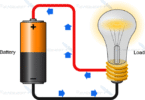
An electric circuit contains a source of moving charge (battery or generator), connecting wires made of conducting materials (usually copper metal) and various electrical devices such as bulbs, switches, resistors, ammeters and voltmeters.
Voltmeters measure potential difference in volts. While resisters opposes the flow of current. The circuit may also contain devices for controlling the amount of current. These include:
- Rheostat
- Fuse
- Circuit breakers, as well as devices for measuring current such as ammeters and galvanometers.
The table below shows list of some common circuit component and their purpose.
| Circuit device | Purpose |
| Connecting wire | Carry current from point to point in a circuit. |
| Wire joined | |
| Wire crossing (can be connected) | |
| Cell | Supplies electrical energy |
| Battery (4 cells) | Supplies electrical energy |
| Battery (multiple cells) | |
| Alternating current (AC) supply | |
| Lamp/bulb | Supplies electrical energy |
| Resistor | Impedes the flow of current |
| Switch | Open and closes a circuit |
| Rheostats (variable resistors | Control amount of current. For example the brightness of a lamp) |
| Galvanometer | Detecting the presence of current |
| Ammeter | Measures current |
| Milliammeter | |
| Voltmeter | Measures potential Difference (voltage) |
| Capacitor | Store charges |
Simple Electric Symbols
Identify simple electric symbols
Explain the concept of Current, Voltage and Resistance
CURRENT
An electric current in a material is the passage of charge through the material. In metals free electrons carry charge. In solutions such as sodium chloride it is carried by charged particles known as ions.
Insulators like wood and plastic do not contain charge carriers at all as every electron is firmly fixed onto their atoms. The electrons are not free to move.
The rate of flow of electrons in a material is called electric current. It is measured in amperes (A) using an Ammeter. Connection can damage them. Therefore when connecting the ammeter, the red wire should be connected to the +ve terminal of a battery.
A current of 1A is equivalent to a flow of6.25 x 1018electrons per second and 1 electron has a charge of 1.6x 10⁻¹⁹c.
Current in simple circuit is the same at all points.
Once the circuit is complete, electric charges inside cells and other sources of electric charge are forced out into the circuit.
The electric energy is normally given out as light and heat, as energy goes through the bulb. A car headlamp has about 4A of current passing through it while a small torch uses about 0.2A.
VOLTAGE
When several cells have been joined together, they form a battery. Every cell has a voltage, commonly referred to as potential difference (p.d). This potential difference (p.d) causes the flow of electrons (charges) in a circuit.E.g. A dry cell has a voltage of 1.5v. This voltage is normally marked on the cell.
Voltage is measured by using a voltmeter. The SI unit for voltage is the volt (V). If each coulomb if charge is given 1 joule of potential energy, then the p.d across the terminals of a battery is 1 volt.
The p.d between the ends of a connecting wire is zero since there is almost no loss of potential energy over this section.
P.d across the battery = sum of p.d around a conducting path, whereas voltage provides the driving force to an electric current, this force is always opposed.
RESISTANCE
Is the opposition flow to an electric current. As current flows through the circuit it encounters some opposing force. This force determines the amount of current flowing in an electric device.
The property of conductors that oppose the flow of electric charges depends on the relationship between current and voltage across their ends as discovered by George Ohm. He observed that voltage across a conductor was directly proportional to electric current flowing through it provided that temperature and other physical conditions of the conductor were kept constant.
Hence, V x I
V= IR
R is the constant of proportionality. This constant is called resistance and the above relationship is known as Ohms law.
Resistant (R) = p.d across the conductor/Current through the conductor
Therefore a resistance of 1ohm is obtained when a p.d of 11V cause a current of 1A to flow in a circuit.
| name | symbol | conversion | example |
| milli-ohm | mΩ | 1mΩ = 10-3Ω | R0 = 10mΩ |
| ohm | Ω | – | R1 = 10Ω |
| kilo-ohm | kΩ | 1kΩ = 103Ω | R2 = 2kΩ |
| mega-ohm | MΩ | 1MΩ = 106Ω | R3 = 5MΩ |
A resistor
Is a device especially designed to offer resistance to the flow of an electric current, Resistors include rheostats (variable resistor) and fixed resistors.
Ohm’s Law
Ohms law states, “At constant temperature and other physical factors, the potential difference across the end is directly proportional to the current passing through a conductor (wire).”
A graphical representation of Ohm’s law. The graph of voltage against current
The gradient of the particular graph represents resistance. This is constant for a particular wire or conductors. Doubling the voltage would double the current; a graph of this kind passes through the origin.
FACTORS THAT AFFECT THE RESISTANCE OF A CONDUCTOR
The resistance of a conductor is affected by the following factors:
Length of the conductor
The longer the wire, the higher the resistance, short lengths of wire produce resistors of low resistance while long lengths of the same wire are good for high – value resistance.
Temperature
An increase in temperature of a conductor means an increase in its resistance and vice versa. This is important in resistance thermometers. The resistance of metal conductor increases with increase in temperature.
Types of material
The conducting ability of the material has to be considered. A chrome wire has more resistance than a copper wire of the same dimension. That is why copper is mostly used for connecting wire.
Cross – sectional area
A thin wire has more resistance than a thick conductor. The filament of a bulb is made of very thin tang stem wire. It therefore has a high melting point.
With all other factors being equal, a long wire has more resistance than a short wire and thin wire has more resistance than a thick one. Therefore resistance of a conductor varies depending on the current flow.
The SI Units of Current, Voltage and Resistance
State the SI units of Current, Voltage and Resistance
Current
The rate of flow of electrons in a material is called electric current. It is measured in amperes (A) using an Ammeter. The SI unit for current is ampere.
Voltage
Voltage is measured by using a voltmeter. The SI unit for voltage is the volt (V)
Resistance
Resistant (R) = p.d across the conductor/Current through the conductor. The SI unit for resistance is Ohm.
Connecting Simple Electric Circuits
Connect simple electric circuits
CONSTRUCTION OF SIMPLE ELECTRIC CIRCUITS
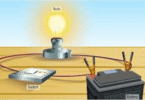
Consider a circuit consisting of a battery, a switch and 2 bulbs.
When the switch is closed, current flows through the wires and the bulbs light up. The circuit is said to be complete. When the switch is opened, no current flows through the wire, as the path carrying current is broken. The circuit is said to be incomplete.
If we want to be able to control the brightness of the lamp, we include a rheostat into the circuit.
In a circuit an ammeter is always connected in series with the battery. Current has to pass through the ammeter if it is to be measured correctly.
Unlike an ammeter, a voltmeter must be connected in parallel with component so as to measure the voltage drop across it. The figures show a simple electric circuit in which the ammeter and voltmeter are connected in series and parallel respectively.
As already learnt, resistance is the ratio of the potential difference across the ends of the conductor,a very good conductor will have 0 resistance.
Resistance of resistor R could be calculated using the formula:- R = V/I
R = V/I
Not that the rheostat (variable resistor) moves, it varies with the length of the conductor being used.
Example 1
A battery of 5V has a resistance wire of 20Ω connected to it. Calculate the current in the circuit.
Solution;
I = V/R = 5V/20Ω
I = 0.25A
Therefore,
Current in the circuit = 0.25A
Example 2
Calculate the reading of the Voltmeter P and the ammeter Q in the electric circuit below.
Solution:
Being a single loop circuit, current is the same at all points.
Q = 3A
Sum of p.d in external circuit = p.d across battery
3V + P = 13V
P = 10V
Therefore:
Q = 3A and Voltmeter P = 10V
Note: for a single loop or simple circuit.
- Current is the same at all points around the circuit
- The sum of the potential differences around a conducting path from one battery terminal to the other terminal within the circuit is the same as the p.d across the battery.
Electric Current and Voltage
Measure electric current and voltage
MEASUREMENT OF ELECTRIC CURRENT
Since we cannot see electric current to measure it, we must observe some of its visible effects, like deflection of pointers.
Beside an ammeter, an electric current is measured using Milliammeter and microammeters. These devices are normally connected in series with the source of current e.g. circuit with a galvanometer connected in series.
Galvanometer in series
Galvanometer can only measure very small current of a few hundred microamperes. To measure large currents a resistor is added to make current flow through it and a very small amount of current flows to the galvanometer. This combination is called an ammeter.
On the other hand voltage is measured depending on the amount of current passing through the circuit. In Ohmic device it is given as V^I.
Simple Electric Circuits
Analyse simple electric circuits
Combination of resistors
There are two main methods of connecting circuit components, in series or in parallel. Resistors can be connected either in series or in parallel depending on the desired output.
Series combination
In series arrangement the resistors are connected end to end.
In a simple circuit
V = V1 + V2 or V- (V1 + v2)= 0
This means that the sum of the p.d across the resistors is the same as the p.d across the battery.
Current is the same at all points around the circuit.
Resistors connected in series
Parallel combination
Resistors are connected across two common points in a parallel arrangement.
Note; Potential difference is from a single source and so is the same for all the branches. However the current is different in each branch.
From Ohm’s law;
Note:
When bulbs have to be powered by a single source of electric current, the bulbs are connected in parallel. This is practiced in car and home lighting system.
The advantage of parallel arrangement over series arrangement is that:
- The full p.d of source is applied across each bulb irrespective of the number of bulbs.
- Switching one bulb on and off does not affect the others.
Example 3
consider the figure below:
Given that the p.d a cross the cell is 24V, calculate the p.d across the 4Ω and 6Ω.
Solution;
Total resistance in the circuit = 4Ω + 6Ω= 10Ω
Using Ohm’s law. I = V/R,
Current in the circuit = 24V/10Ω= 2.4A
This implies the 2.4A passed through the 4Ω resistor.
The pd across it can be obtained through V=IR
p.d = 2.4A x 4N = 9.6V
Note that the p.d across two resistors adds up to the battery p.d.
p.d across the 6Ω = (24-9.6) V
= 14.4V
Therefore,
P.d across the 6Ω =14.4V