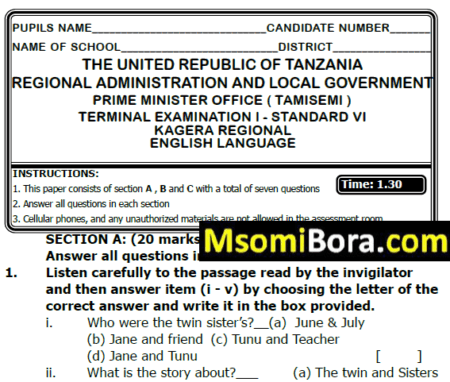
Kagera – Mitihani ya Darasa la Sita | Terminal 2026 | Download All Subjects
Swahili Medium
The exams have been combined in one Pdf
..
..
Within particular subject areas – or in specialist schools – there is potentially a debate about the need to develop specific abilities (“intelligences” in Gardner’s term), possibly through “apprenticeship” approaches of the kind mentioned by Hodgkin. The debate among cognitive psychologists about the bases for learner’s development also raises questions about the appropriateness of the common curriculum. The arguments of writers like Rogers (1959, 1969) about individual and group creativity and freedom to pursue one’s own values also raise issues about the curriculum. There is movement towards engagement in such a debate in current thinking within SEED, HMIE and L & TS about curricular reform.
Among the basic needs that children should get is good education. Therefore, getting a good school for a child is every parent’s priority. Nonetheless, it is quite difficult to come to a consensus as it regards what makes a good school. Despite this, it is important to note that there are fundamental qualities that a good school should poses.
To begin with, a good school should have the required facilities to make learning possible. These include the necessary buildings as well as learning equipment. A good school is one that has enough classrooms so that students can fit in without being overclouded.
The recent SCRE review (summarised in Spotlight 92, Hall 2005) offers a number of important reminders of what is currently known for sure about neuroscience and education, as opposed to “myths”. The review begins with a cautionary section, based on 1997 work by John Bruer, indicating that discoveries about the physiology and organisation of the brain do not lead inevitably and quickly to practical classroom applications and that cognitive psychology still has a significant role in informing educational activity.