




TOPIC 8: NUMBERS (II)
Rational Numbers
A Rational Number
Define a rational number
A Rational Number is a real number that can be written as a simple fraction (i.e. as a ratio). Most numbers we use in everyday life are Rational Numbers.
| Number | As a Fraction | Rational? |
| 5 | 5/1 | Yes |
| 1.75 | 7/4 | Yes |
| .001 | 1/1000 | Yes |
| -0.1 | -1/10 | Yes |
| 0.111… | 1/9 | Yes |
| √2(square root of 2) | ? | NO ! |
The square root of 2 cannot be written as a simple fraction! And there are many more such numbers, and because they are not rational they are called Irrational.
The Basic Operations on Rational Numbers
Perform the basic operations on rational numbers
Addition of Rational Numbers:
To add two or more rational numbers, the denominator of all the rational numbers should be the same. If the denominators of all rational numbers are same, then you can simply add all the numerators and the denominator value will the same. If all the denominator values are not the same, then you have to make the denominator value as same, by multiplying the numerator and denominator value by a common factor.
Example 1
1⁄3+4⁄3=5⁄3
1⁄3 +1⁄5=5⁄15 +3⁄15 =8⁄15
Subtraction of Rational Numbers:
To subtract two or more rational numbers, the denominator of all the rational numbers should be the same. If the denominators of all rational numbers are same, then you can simply subtract the numerators and the denominator value will the same. If all the denominator values are not the same, then you have to make the denominator value as same by multiplying the numerator and denominator value by a common factor.
Example 2
4⁄3 -2⁄3 =2⁄3
1⁄3-1⁄5=5⁄15-3⁄15=2⁄15
Multiplication of Rational Numbers:
Multiplication of rational numbers is very easy. You should simply multiply all the numerators and it will be the resulting numerator and multiply all the denominators and it will be the resulting denominator.
Example 3
4⁄3×2⁄3=8⁄9
Division of Rational Numbers:
Division of rational numbers requires multiplication of rational numbers. If you are dividing two rational numbers, then take the reciprocal of the second rational number and multiply it with the first rational number.
Example 4
4⁄3÷2⁄5=4⁄3×5⁄2=20⁄6=10⁄3
Irrational Numbers
Irrational Numbers
Define irrational numbers
Our mathematics expert has prepared the video Irrational number, take your time to go through

Tutorial Created by Willbald Mvungi-Ilboru Secondary
An irrational number is areal number that cannot be reduced to any ratio between an integer p and a natural number q. The union of the set of irrational numbers and the set of rational numbers forms the set of real numbers. In mathematical expressions, unknown or unspecified irrationals are usually represented by u through z. Irrational numbers are primarily of interest to theoreticians. Abstract mathematics has potentially far-reaching applications in communications and computer science, especially in data encryption and security.
Examples of irrational numbers are √2 (the square root of 2), the cube root of 3, the circular ratio pi, and the natural logarithm base e. The quantities √2 and the cube root of 3 are examples of algebraic numbers. Pi and e are examples of special irrationals known as a transcendental numbers. The decimal expansion of an irrational number is always non-terminating (it never ends) and non-repeating (the digits display no repetitive pattern)
Real Numbers
Real Numbers
Define real numbers
The type of number we normally use, such as 1, 15.82, −0.1, 3/4, etc.Positive or negative, large or small, whole numbers or decimal numbers are all Real Numbers.
They are called “Real Numbers” because they are not Imaginary Numbers.
Absolute Value of Real Numbers
Find absolute value of real numbers
The absolute value of a number is the magnitude of the number without regard to its sign. For example, the absolute value of written as . The sign before is ignored. This is because the distance represented is the same whether positive or negative. For example, a student walking 5 steps forward or 5 steps backwards will be considered to have moved the same distance from where she originally was, regardless of the direction.
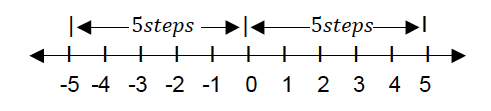
The 5 steps forward (+5) and 5 steps backward (-5) have an absolute value of 5
Thus || = when is positive ( ≥ 0), but || = − when is negative ( ≤ 0).
For example, |3| = 3 since 3 is positive (3 ≥ 0) And −3 = (−3) =3 since −3 is negative (3 ≤ 0)
Related Practical Problems
Solve related practical problems
Example 5
Solve for || = 5
Solution
For any number , || = 5, there are two possible values. Either ,= +5 = 5
Example 6
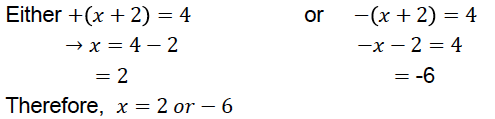
Solve for , given that | + 2| =4
Solution
Exercise 1
1. What must be added to -1 to make 2 ?
2. Solve for x if /3x-1/ = 5
3. Represent on a number line the solution for /2x-1/=3
4. Represent the following on a number line -3≤x≤3
5. Sketch the graph of the equation x-2y=4